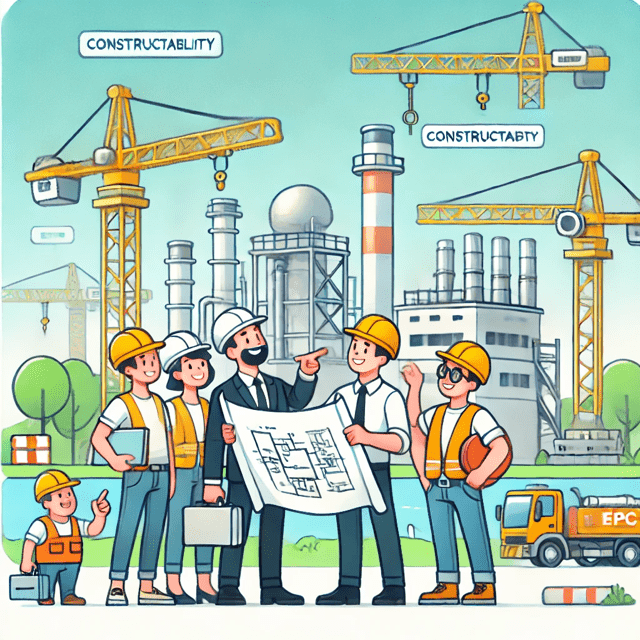
In EPC projects, one of the most persistent misconceptions is that perfect drawings alone guarantee successful plant construction. Many teams believe that if the engineering model is detailed enough, accurate enough, and beautifully coordinated, the project will naturally flow in the field.
But here’s the truth: designs don’t build plants—constructability does.
You can produce the most precise 3D models, the cleanest routing, and the tightest specifications. Yet if the field team cannot build the design safely, efficiently, or within the planned work fronts, the engineering becomes a bottleneck rather than a solution. Good engineering is not just about design excellence—it’s about building reality, not theory.
Why Great Engineering Goes Beyond Paper
True engineering success isn’t measured by how perfect drawings look on a screen. It’s measured by how smoothly, safely, and efficiently the design can be built in real-world conditions. That requires practical, hands-on thinking built into every decision.
Great engineering considers:
🔹 Installation Logic
Assemblies must be designed so they can be built in the correct sequence—without constant rework, clashing work fronts, or waiting on other disciplines.
🔹 Access Considerations
Design should allow safe, easy movement of personnel, tools, equipment, and materials. Tight spaces on drawings become real-world safety hazards if not planned properly.
🔹 Lifting Paths and Modularization
Good design anticipates crane movements, rigging clearances, and prefabrication opportunities. If a module cannot be lifted or rotated safely, it’s not constructible.
🔹 Maintenance and Operational Needs
Construction is only the first phase of a plant’s life. Design must allow safe maintenance, easy replacement of components, and efficient long-term operation.
🔹 Human Realities of Construction
Things like ergonomics, fatigue, line-of-sight, temperature, and weather matter. Field teams work in the real world—not in controlled office environments.
Every line on a drawing eventually becomes a real weld, a real fit-up, a real lift, and a real risk. Field crews feel the consequences of every engineering choice. When constructability isn’t considered, the people on-site are the ones paying for it—through delays, safety challenges, and unnecessary rework.
The Power of Engineering–Construction Collaboration
Projects succeed when engineering and construction do not work in silos. They succeed when both teams think together, plan together, and challenge each other through constructive dialogue.
Here’s how to make that collaboration effective:
1️⃣ Early Involvement of Supervisors
Construction supervisors bring real-world context. Their practical insights can prevent expensive design mistakes long before they reach the field.
2️⃣ Field Feedback Loops
Designers should regularly review lessons learned and feedback from previous sites. This develops engineering maturity and reduces repeat mistakes.
3️⃣ Constructability Reviews During Design
Every model review should include site perspectives. This helps identify clashes, unsafe access routes, impractical lifts, or unrealistic sequencing early.
4️⃣ Joint Problem-Solving Sessions
When engineers and construction teams solve problems together, the project benefits from combined expertise. Design decisions become more realistic and field-friendly.
When constructability is embedded in the design process, issues disappear before they ever have the chance to impact schedule, cost, or safety.
When Constructability Is Ignored, Projects Pay the Price
Lack of constructability thinking leads to:
- Rework
- Schedule delays
- Cost overruns
- Unsafe work fronts
- Unbuildable designs
- Labor productivity drops
- Poor morale and operational frustration
These impacts compound quickly in EPC work, where every delay can cascade through multiple work fronts and disciplines.
The reverse is also true: strong constructability improves safety, cost, productivity, and client satisfaction.
The Bottom Line
At the end of the day, one principle stands tall:
If it cannot be built, it doesn’t matter how well it was designed.
The most beautiful engineering drawings mean nothing if they don’t translate into practical, safe, efficient execution in the field.
Constructability ensures that engineering decisions become real, buildable solutions. It reduces rework, eliminates surprises, shortens timelines, and improves overall project performance.
This is why the strongest EPC teams treat engineering and construction as partners—not stages. They design with the field in mind, and they execute with engineering support, clarity, and alignment.
Join the Conversation
If this resonates with you, like, comment, or share your experience.
How do you ensure constructability in your EPC projects?
Your insights could help someone deliver a safer, faster, and more efficient project.


