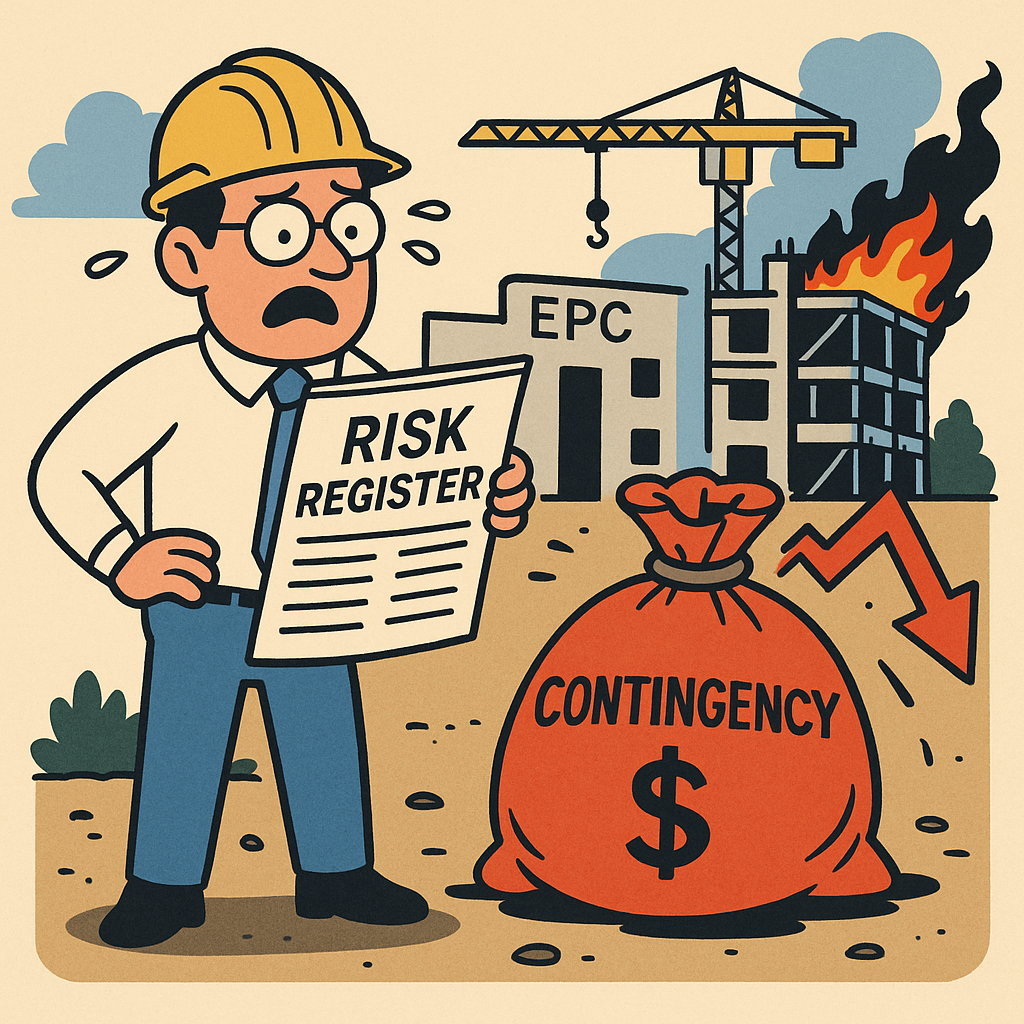
In Engineering, Procurement & Construction (EPC) projects, we proudly showcase thick risk registers—hundreds of rows, color-coded heat maps, probability charts, and detailed mitigation actions.
It looks impressive.
It feels reassuring.
But when the first real shock wave hits—design revisions, vendor failure, political delays, or a scope explosion—projects still bleed millions. Margins vanish, schedules slip, and leadership scrambles for answers.
So if we did everything right… why do EPC projects still fail?
⚠️ The Real Problem: Disconnected Contingencies
A risk list is not a safety net if it’s not directly tied to money, reserves, and decision authority.
Logging 200 risks means nothing if your $50M contingency only covers a handful
Schedule buffers disappear with the first major scope change
Risk registers turn into project theatre when they don’t support financial readiness
Most EPC teams track risk probabilities and severity—but they rarely map actual funding capacity vs. exposure. The result? False confidence.
A thick register gives visibility.
A funded register gives survivability.
✅ What Actually Works
To turn risk management from documentation to defense, EPC leaders need real operational readiness.
1. Every risk gets a price tag
If the financial impact isn’t quantified, you’re guessing—not managing.
2. Every contingency needs an owner
If nobody owns the cash and decision trigger, it’s a phantom reserve.
3. Remove invisible reserves
Budget padding buried inside work packages is not contingency—it’s wishful thinking.
4. Flag under-covered risks early
If a cluster of high-impact risks emerges, leadership needs early warning, not post-mortems.
🛠️ What Early Flags Enable
When escalation triggers are defined, teams gain options:
🔄 Deploy management reserves (if available)
📝 Re-baseline or renegotiate when unforeseeable risks hit
⏱️ Trigger pre-approved actions before the cost curve spirals
📉 Prepare for a controlled write-down instead of a surprise disaster
If you can’t fund or escalate the mitigation,
it’s not risk management—it’s decoration.
👔 The Smart Project Leader’s Questions
To cut through noise, ask:
1️⃣ What is our true exposure after contingencies?
2️⃣ Which risks, if clustered, could cripple the project?
3️⃣ Do we have the liquidity and authority to act at the trigger point?
Boards don’t care if you color-coded 500 lines in Excel.
They care whether you saw the iceberg in time to turn the ship.
📝 The Best EPC Risk Register Covers
Not everything—only what matters:
Top-critical risks, not every hypothetical one
Funding allocated and traceable
Clear decision triggers
Escalation paths within minutes, not weeks
Projects fail when risk management becomes documentation instead of defense.