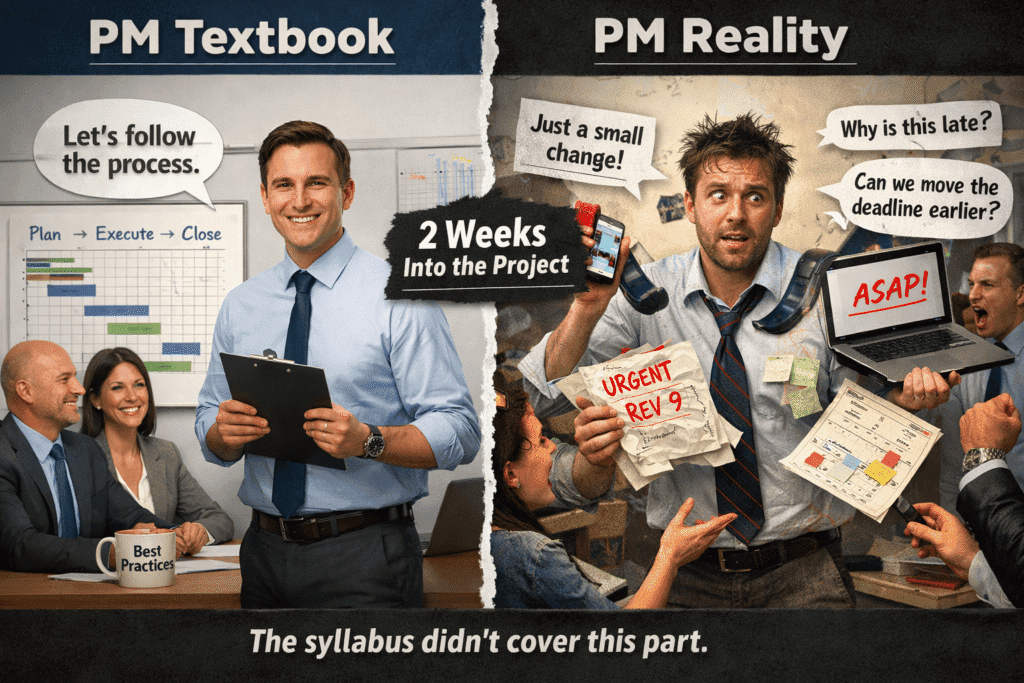
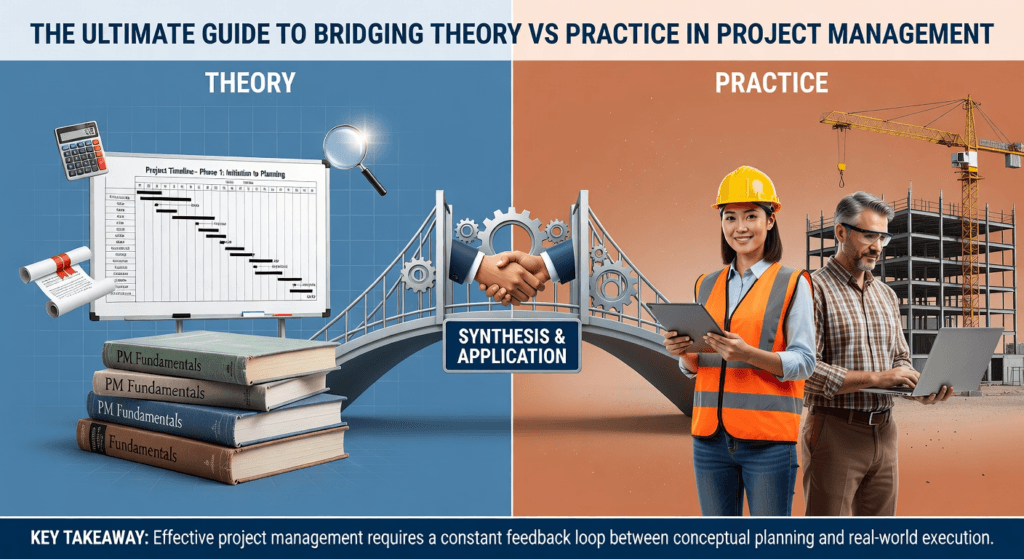
Theory vs practice is the gap every project manager eventually confronts. Textbooks promise clear scope, rational decisions, and aligned stakeholders. Real projects deliver politics, shifting priorities, and risks nobody saw coming. This is what theory vs practice actually looks like — from decades of first-hand delivery experience.
Then you step into a real project.
Suddenly, scope evolves mid-delivery. Plans exist but aren’t followed. Risks appear where no one expected. Stakeholders pull in different directions. Decisions are emotional, political, and made with incomplete information.
This isn’t because project management theory is wrong—it’s because textbooks describe ideal conditions, while real projects exist in messy human, organizational, and operational realities.
Here’s a practitioner’s perspective on what textbooks say vs. what actually happens, drawn from decades of firsthand experience.
1. Scope: Theory vs Practice on Real Projects
Textbooks say:
Define scope clearly at the start and maintain control through formal change management.
Reality:
In my decades of project delivery experience, scope is rarely settled on day one.
Several factors contribute:
- Sales process spillover: Deals are closed on promises and assumptions. Execution exposes gaps.
- Stakeholder “dreams”: Once early outputs are visible, stakeholders refine their vision—often beyond the original scope.
- Contract interpretation: Many projects are governed by contracts written by lawyers on both sides, leading to differing interpretations of what is “in scope.”
Practitioner insight:
Effective scope management isn’t about freezing scope—it’s about continuously aligning commercial intent, stakeholder expectations, and delivery reality, while making trade-offs explicit before they turn into conflict.
2. Planning: “Follow the Plan” vs. Reality
Textbooks say:
Create a detailed project plan, baseline it, and track progress against it.
Reality:
Plans often remain documents on paper, owned and updated primarily by PMs or planners. They track and revise the plan diligently—sometimes just to explain why reality diverged from it.
Plans fail when:
- Functional stakeholders don’t buy in to the timelines or deliverables.
- Project dynamics change constantly—dependencies shift, resources are reassigned, priorities evolve.
Practitioner insight:
The real value of planning is not in defending a fixed plan. It’s in providing a flexible framework that guides execution. Plans must be agile, continuously re-aligned, and used as a tool to enable delivery, not constrain it.
For tools that help manage dynamic timelines, check out my Simple Deadline Tracking for Projects That Must Get Done.
3. Risk Management: Theory vs Practice When Stakes Are High
Textbooks say:
Identify risks early, quantify their probability and impact, and track them in a risk register.
Reality:
I’ve seen PMs spend hours crafting beautiful, exhaustive risk registers, only to miss the critical risks that actually threaten delivery.
While textbook approaches teach how to quantify risks, the challenge is objectivity. In real projects, some risks—political resistance, resource instability, morale issues—don’t appear neatly in spreadsheets. Inventing risks doesn’t protect the project; failing to track the real ones does.
Practitioner insight:
Focus on a concise, living list of critical risks, explicitly linked to cost, schedule, and contingency. Track and respond to these. Real risk management is about prioritization, early detection, and timely action—not documentation volume.
You can explore practical risk tracking techniques with my Project Risk Vs Contingency Tool.
4. Stakeholder Alignment: The Theory vs Practice Gap Nobody Talks About
Textbooks say:
Formal governance structures ensure stakeholders align and decisions are made efficiently.
Reality:
Most organizations operate as strong functional setups, not ideal project matrices. Functional dominance often leads to:
- Misaligned KPIs (project vs. department)
- Resource decisions driven by functional priorities or ego
- Projects stuck in limbo as different functions pull in competing directions
For example, I’ve seen resources pulled from critical projects to satisfy another department’s priorities or “urgent” customer requests. Governance structures existed, but they couldn’t overcome functional misalignment.
Practitioner insight:
Formal governance is only part of the solution. True alignment happens when incentives, KPIs, and decision rights support project outcomes. PMs must actively negotiate priorities and make trade-offs visible—often outside formal forums.
For building trust and alignment, see Building Trust: The Key to Successful EPC Projects.
5. Decision-Making: “Rational and Data-Driven” vs. Reality
Textbooks say:
Decisions are rational, objective, and based on complete data.
Reality:
Decisions are often shaped by ego, stakeholder pressure, and politics, rather than delivery logic.
On one particularly complex project, key team members were pulled from our critical initiative and redeployed to a relatively simpler project. The reason wasn’t delivery priority—it was an imaginary target completion date conceived by a senior client-side leader who wanted quick commissioning of the project, which was never feasible in reality.
The complex project suffered, but the decision was defended as “strategic.”
Practitioner insight:
Effective PMs learn to anticipate political drivers, highlight consequences early, and document trade-offs clearly. While they may not control every decision, they can ensure the impact of decisions is understood before damage occurs.
For deeper insights on breaking conventional rules to make effective decisions, see The Best Project Managers Break the Rules (On Purpose).
6. The Takeaway: What Theory vs Practice Teaches You That Books Never Will
Textbooks provide tools, frameworks, and credibility. They teach methods and processes.
Real projects test judgment, adaptability, and human skills. The difference between an average PM and a great PM isn’t certification—it’s the ability to:
- Read the room
- Manage uncertainty
- Protect the team
- Make imperfect calls early
The part that matters most in practice isn’t in the books—but it defines success.
Listen to This Article as a Podcast
Design by ratish sFAQ
Are textbooks wrong?
No. They simplify complexity to provide a common language and foundational structure. Real projects require adapting that knowledge.
Should PMs ignore methodologies once experienced?
No. Methodologies give structure and credibility. The skill is knowing when and how to adapt them.
Why do certified PMs struggle?
Exams test knowledge, not judgment. Real projects test negotiation, resilience, and influence under pressure.
Is Agile more realistic than traditional PM?
Agile handles uncertainty better, but it doesn’t remove politics, conflicting incentives, or human behavior.
What skill is under-taught in textbooks?
Difficult conversations, early escalation, and influencing without authority—skills that protect the project before problems become crises.
For additional reading please also refer to sites below to enrich your knowledge on this topic and diversify your learning: