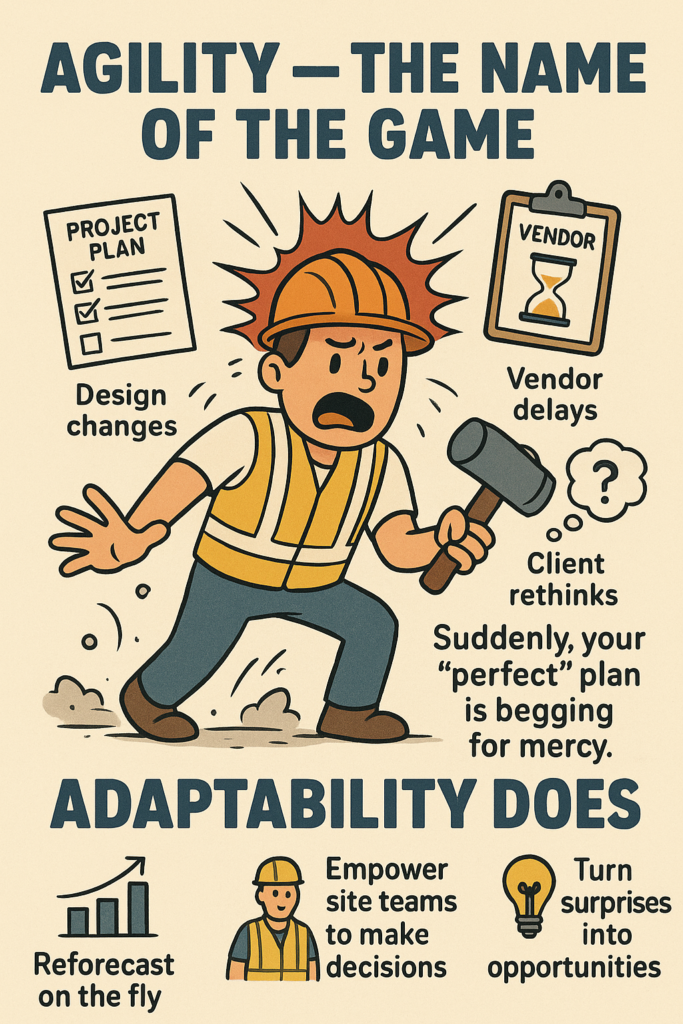
An EPC plan can look perfect on day one, then reality shows up. A vendor slips a delivery date, the client issues a late design change, a key crew lead quits, rain shuts down lifts, and commodity prices swing hard enough to blow up your forecast. If you’ve managed more than one job, you’ve lived some version of that week.
That’s where Agility matters, not as a buzzword, and not as “no plan.” In EPC work, it’s simple: fast learning plus fast decisions. You plan, you watch what’s actually happening, then you adjust before small issues turn into stoppages, rework, and claims.
This post lays out a practical playbook: what agility looks like on real EPC projects, how top teams run the work when conditions shift, and a short set of habits you can start next week.
What agility looks like in real EPC work (and what it is not)
Agility in EPC isn’t about moving fast for the sake of it. It’s about keeping engineering, procurement, and construction in sync as the job moves. When a project is agile, it feels calmer on site because people aren’t waiting days for answers, crews aren’t idle, and the schedule reflects what’s true today, not what was true three months ago.
Here’s what that looks like in practice:
- Engineering releases match construction sequence, so the field isn’t guessing on incomplete IFC packages.
- Procurement tracking is tied to install needs, not just PO dates, so you can spot “late-to-site” risks early.
- Construction planning gets refreshed often, based on actual quantities installed and constraints cleared.
The outcomes a PM cares about are plain: fewer work stoppages, fewer RFIs that sit, fewer “rip it out and do it again” moments, and tighter control of cost and schedule. It also reduces the stress that comes from surprises, because you’re treating surprises as normal inputs, not emergencies.
Agility also changes the tone of coordination. Instead of long meetings where people defend their lane, you get short, focused check-ins where the team answers, “What changed, what does it impact, what are we doing next?”
Agility means re-planning often, not guessing once
Most EPC schedules fail slowly, then suddenly. A single slip (say, switchgear) can cascade into civil, electrical, commissioning, and turnover. Agile teams use rolling-wave planning to keep the next few weeks detailed, while the later months stay higher level until the project learns more.
A simple example: a supplier pushes a delivery by three weeks. A rigid plan keeps the original sequence and the crew goes idle. An agile plan re-sequences. The team shifts to cable tray in zones that are ready, pulls forward terminations that don’t depend on the delayed gear, and moves inspections earlier where possible. The crew stays productive, and you avoid burning money on standby.
The artifacts are basic, but they work:
- A 2-week lookahead tied to crew commitments
- An updated critical path that reflects real dates
- A constraint log (what’s blocking work, who owns it, when it clears)
Agility is not chaos: guardrails keep the project safe
Fast decisions only help if you don’t create defects, safety events, or contract messes. Some things should change slowly, even on the most adaptive project: safety rules, quality hold points, permit conditions, formal change control, and document version control.
A few guardrails that keep agility clean:
- Approval limits: who can approve field changes, and up to what dollar value
- Stop-work triggers: conditions that require a pause (permit conflict, failed hold point, critical safety hazard)
- Version control rules: one current drawing set, one controlled mark-up path
- Change thresholds: when a “small tweak” becomes a formal change request
If you want a deeper view of how EPC firms are organizing around faster decisions and better information flow, see the MIT research on enterprise architecture in plant engineering.
How top EPC teams pivot fast when reality changes
In late 2025 and into 2026, EPC teams have been dealing with a tough mix: supply volatility, labor shortages, and higher costs. Those pressures show up in real ways, like long lead equipment that won’t commit, crews stretched across multiple sites, and owners who want speed but also want price certainty. Deloitte’s 2026 engineering and construction outlook captures that tension across the industry.
Top teams don’t “power through” with the original baseline. They pivot without losing control. The difference is visible when you compare the before and after:
- Before: the plan gets updated monthly, the field waits for answers, and cost impacts surface late.
- After: schedule and cost get refreshed often, the site can decide within limits, and changes become a chance to remove waste.
Three behaviors show up again and again.
Reforecast on the fly with one source of truth
Agile EPC teams treat progress as live data, not a weekly debate. The cadence doesn’t have to be heavy:
- Daily field progress update (installed quantities, blockers, photos)
- Weekly schedule refresh (logic checks, critical path updates, resequencing)
- Quick cost-to-complete check (labor hours burned vs earned, major open commitments)
Cloud dashboards and alerting tools can help, but the core is the discipline of keeping one set of numbers that engineering, procurement, construction, and controls agree on.
Mini checklist for a fast reforecast that doesn’t bog down:
- Update installed quantities and percent complete
- Confirm constraints for the next 2 weeks
- Re-sequence around late materials or access limits
- Communicate changes to subs and the client the same day
When teams do this well, the schedule becomes a tool crews trust, not a document they ignore.
Push decisions to the site, with clear limits
Site teams see problems first. They also pay the price when approvals drag. The fix isn’t to bypass engineering or the client, it’s to create a simple decision matrix that removes bottlenecks.
A practical way to set it up:
- Field can approve: minor routing changes within tolerance, small supports, swaps from a pre-approved alternates list
- Engineering must approve: anything that changes load paths, code compliance, or critical interfaces
- Client must approve: scope changes, aesthetic changes, or anything above agreed cost and schedule thresholds
One common win: a late interference shows up during install. With pre-set limits, the superintendent can approve a small reroute and issue a redline the same shift. Engineering reviews and stamps within 24 hours. Without that, the same issue can sit for a week, then turn into overtime and missed inspections.
Turn surprises into wins by asking “what can we improve now?”
Some changes are pure pain. Others expose a better path that you would’ve missed if the baseline never got challenged.
Example: a last-minute client change forces a layout tweak. The team uses the disruption to re-check access and lift plans. They find a simpler install path, reduce crane picks, and cut risk on congested work fronts. The change still costs money, but it also removes future friction.
In 2026, this mindset pairs well with modular and prefab options when they fit. Prefab racks, skids, or assemblies can reduce on-site labor hours when skilled trades are tight. The point isn’t to prefab everything, it’s to ask where repetition and congestion are killing you.
Make the learning stick with a short after-action review:
- What surprised us?
- What decision helped, or hurt?
- What standard should we update for the next job?
If you want broader background on agile ways of working (and the common traps), this guide to agile project management is a solid refresher.
A simple agility kit you can start using next week
You don’t need a big “transformation” to get the benefits of Agility. You need a few habits that fit EPC reality and respect safety, quality, and contracts.
Here are six that pay off fast:
Run the job in short horizons: keep the 2-week lookahead tight and realistic, then roll it forward every week.
Treat constraints like deliverables: if a permit, RFI, or submittal is blocking work, assign an owner and due date the same day.
Pre-approve options: build an alternates list for common materials and components before the first shortage hits.
Keep one project truth: one place for the latest schedule, quantities, and constraints, so teams aren’t arguing over versions.
Make the field part of the plan: crews commit to the lookahead, and the lookahead reflects real production, not wishful thinking.
Close the loop: every late decision gets a quick “why,” so the team fixes the system, not just the symptom.
Daily stand-up, weekly lookahead, and a short constraint list
Keep the daily stand-up to 10 minutes, standing, with three questions: What did we finish, what’s next, what’s stuck?
Then run the weekly lookahead with the people who do the work. The constraint list should be short and visible, with just four columns: constraint, owner, due date, status. That list prevents stoppages because it turns “we’re waiting on…” into a tracked commitment.
Fast change and escalation paths, so issues do not sit
Define a rapid decision path before the first crisis. When an issue hits, everyone should know who to call, how fast they respond, and what info is required.
A good minimum packet is simple: a photo, a marked-up sketch, and a one-line cost and schedule impact. Pair that with tight feedback loops between engineering and site, plus quick what-if checks before anyone commits crews or orders.
For PMs who like to compare notes and see how peers are handling the same pressures, the Global EPC Project Management Conference 2026 is one place these topics keep coming up.
Conclusion
EPC success right now depends less on how hard you stick to the first plan, and more on how fast the team adapts when the plan meets reality. Agility shows up as three repeatable moves: reforecast often from one source of truth, push decisions to the site with clear limits, and turn surprises into learning that improves the next week of work.
If you manage EPC projects, what’s one Agility habit that helped on your last job, or what bottleneck would you remove first if you could?
For more such insightful content please subscribe to the blog and read Project Management Lessons from Motherhood: Timeless Leadership Skills


