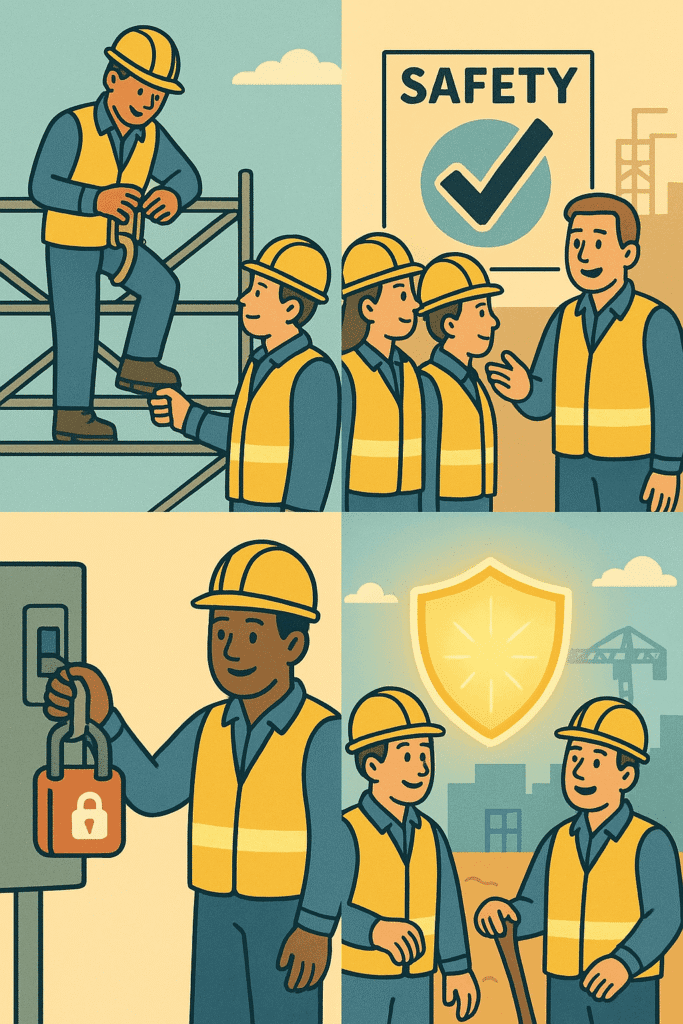
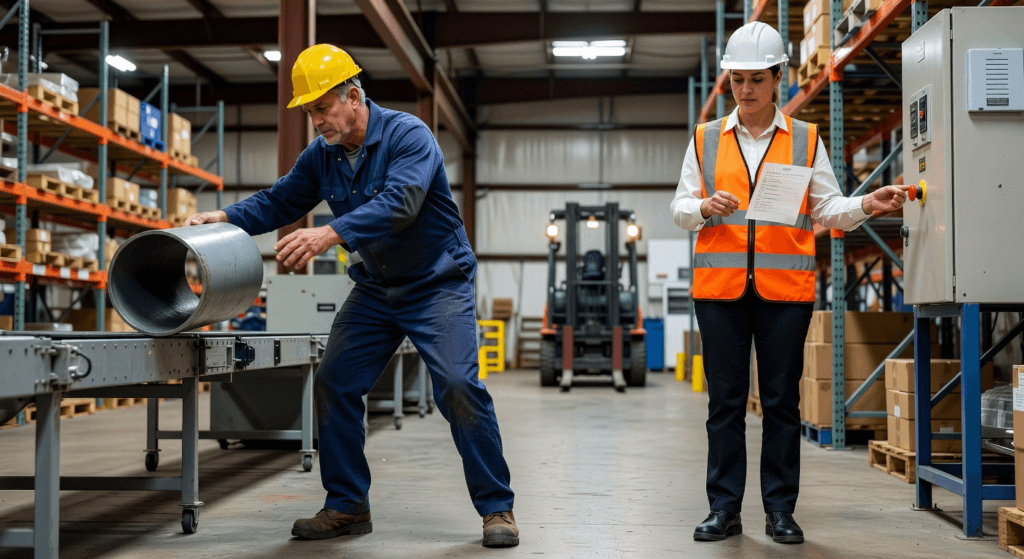
Why this article exists
Safety on construction sites is discussed constantly.
Safety files are thick. Induction programmes are long. Toolbox talks happen every morning. PPE requirements are posted at every entry point.
And yet, incidents happen. Near-misses go unreported. Unsafe equipment gets used. Half-worn PPE becomes normal.
This article is not about safety procedures. It is about why safety culture either takes root or stays superficial — and what genuine ownership of site safety actually looks like in practice.
In brief
Safety cannot be administered from a distance and owned by someone else. On EPC and capital construction projects, the main contractor owns site safety — regardless of how many subcontractors are on site. That ownership is either embedded into how the project is set up, procured, and led — or it is bolted on after the fact. One works. The other produces paperwork.
The ownership question nobody asks clearly enough
When something goes wrong on a construction site, the first question is usually about the subcontractor.
Who was responsible? Which company’s workforce was involved? What does their safety plan say?
In my experience, this framing misses the point entirely.
The main contractor owns site safety. Full stop.
You may administer safety through subcontractors. You may require them to submit safety plans, conduct their own toolbox talks, and manage their own workforce. But the responsibility for whether the site and workplace are genuinely safe sits with the main contractor — not with the subcontractor executing the work.
This distinction matters because it changes how you approach everything. When you understand that you own the safety culture of the site, you stop treating subcontractor safety compliance as someone else’s problem. You start treating it as your own — because it is.
The subcontractors who occasionally demonstrate stronger safety culture than their main contractor are the exception. In my experience, they are rare. And even when they exist, the overall site culture is still shaped by the main contractor’s standards, systems, and leadership behaviour.
What poor safety culture actually looks like
Poor safety culture on a construction site is not hard to recognise if you know what to look for.
It looks like half-worn PPE that nobody challenges. Toolbox talks conducted so quickly they are clearly a box to be ticked rather than a genuine conversation. Near-misses that go unreported because nobody was hurt and nobody wants the paperwork. Unsafe equipment that stays in service because replacing it creates inconvenience.
The common thread across all of these is not malice. It is normalisation.
When unsafe behaviour happens repeatedly without consequence, it stops feeling unsafe. The half-worn hard hat becomes normal. The unreported near-miss becomes a habit. The defective equipment becomes familiar. And then one day, conditions that have been accumulating quietly produce an outcome that surprises everyone — even though, in hindsight, the signals were visible for months.
This is what compliance-based safety culture produces. People follow the rules when someone is watching. They find shortcuts when nobody is. The procedures exist. The behaviour does not match them.
When imposed safety fails: a real example
The difference between imposed safety and owned safety becomes clearest in the moments when the two come into conflict.
I have seen this directly.
On one project in a hot and humid climate, a decision was made from above to mandate additional overalls over the standard site uniform. The intent was genuine — additional protection for the workforce. The implementation was top-down, without consulting the people who would be wearing the overalls in 40-degree heat.
The result was predictable. Workmen began showing physical distress. Heat-related symptoms increased. The very workforce the decision was meant to protect was being put at risk by it.
The policy had to be revisited entirely — this time with input from the people on the ground — to find what was actually optimum rather than what looked correct on paper.
This is what happens when safety is imposed rather than developed. It does not fail because people are resistant to safety. It fails because the people responsible for implementing it were not involved in designing it. The gap between the policy and the reality on the ground was never closed — because nobody building the policy understood the ground.
Safety embedded vs safety bolted on
In my experience, genuine safety leadership looks different from the outside than most people expect.
It is not primarily visible in safety signage, incident statistics, or the thickness of the safety file. It is visible in procurement decisions, work sequencing, and subcontractor selection.
When safety is genuinely embedded in a project, it shows up early:
Subcontractors with poor safety track records do not make it through selection — regardless of their price. Work sequences are planned with safety interfaces considered, not retrofitted after the programme is set. Safety requirements are built into subcontract terms with the same rigour as commercial terms. The project manager asks safety questions during planning reviews, not just during safety audits.
When safety is bolted on, it shows up differently. Safety becomes the HSE manager’s problem. Subcontractor selection is driven by price with safety reviewed separately as a compliance check. Toolbox talks happen because they are required. Near-miss reporting is low — not because the site is safe, but because the culture does not make reporting feel safe.
The difference between these two approaches is not a safety system. It is a leadership decision about where safety sits in the hierarchy of project priorities — and whether that position is real or stated.
How senior leaders unknowingly undermine safety culture
I have not often seen senior leaders deliberately undermine safety culture. But I have seen it happen unintentionally — and the effect is the same.
It happens when a leader visits site and walks past an unsafe condition without stopping. The workforce notices. The message received is not what the leader intended, but it is clear: this does not warrant attention.
It happens when schedule pressure is applied in a way that makes the workforce feel that speed matters more than safety. Nobody says that directly. But when a foreman is under pressure to make up lost time, decisions get made that reflect that pressure — and not always safely.
It happens when near-miss reporting is met with investigation processes so burdensome that the reporting itself feels like a punishment. People learn quickly. They stop reporting.
None of this requires bad intent. It requires only inconsistency between what is said about safety and what behaviour actually signals about priorities.
What genuine safety ownership looks like in practice
The sites I have seen operate with genuinely strong safety culture share a set of behaviours that are worth naming directly.
Unsafe conditions get challenged immediately — not in the next safety meeting, not in a written observation report, but in the moment, by whoever sees them, regardless of their position or the position of the person involved.
Near-misses are reported and treated as valuable information rather than failures requiring blame. The workforce understands that reporting a near-miss is a contribution to site safety, not a confession.
Safety conversations happen at every level — not as formal procedures but as normal site behaviour. A subcontractor supervisor discusses a sequencing concern with the main contractor’s site manager. A workman raises a concern about equipment condition before starting work. These conversations happen because the environment makes them feel normal rather than risky.
Subcontractors are held to the same standards as the main contractor’s own workforce — not because the contract requires it, but because the main contractor understands that a subcontractor incident is their incident.
This is closely connected to how subcontractor relationships are managed more broadly. As I have written in Building Trust in EPC Projects, the quality of the relationship between main contractor and subcontractor determines whether difficult conversations — including safety concerns — happen early or not at all.
Safety culture and project execution
Safety culture does not exist in isolation from project execution. The two are connected more directly than most project managers acknowledge.
Sites with strong safety culture tend to have better execution outcomes across the board — not because safety and performance happen to coexist, but because the conditions that produce genuine safety culture also produce better delivery. Clear accountability. Early escalation of problems. A workforce that feels responsible for outcomes rather than just compliant with instructions.
When the workforce owns safety, they own more than safety. They own the site.
This connects to the broader challenge of building project systems that deliver — the culture of ownership that produces safety is the same culture that produces schedule adherence and quality performance.
Frequently Asked Questions
Who is ultimately responsible for safety on an EPC construction site?
The main contractor. Regardless of how many subcontractors are on site, regardless of how safety is administered through subcontract terms and safety plans, the main contractor owns the site safety culture. You can delegate safety administration. You cannot delegate safety responsibility.
Why does top-down safety imposition often fail on construction sites?
Because it is designed without understanding the reality it is being applied to. A safety requirement that looks correct on paper but creates genuine operational problems — like mandating additional PPE in extreme heat — puts the workforce at risk rather than protecting them. Effective safety requirements are developed with input from the people who will implement them, not handed down to them.
What does poor safety culture look like in practice?
Half-worn PPE that nobody challenges. Toolbox talks conducted as a compliance exercise rather than a genuine conversation. Near-misses that go unreported because nobody was hurt. Unsafe equipment that stays in service through familiarity. The common thread is normalisation — unsafe conditions stop feeling unsafe because they have been present long enough without consequence.
How does safety get embedded into a project rather than bolted on?
Through procurement, sequencing, and subcontractor selection — not through the safety file. When subcontractors with poor safety records do not make it through selection, when work sequences are planned with safety interfaces considered, and when the project manager asks safety questions during planning reviews rather than only during audits, safety is embedded. Everything else is bolted on.
How do senior leaders unintentionally undermine safety culture?
By being inconsistent between what they say about safety and what their behaviour signals about priorities. Walking past an unsafe condition. Applying schedule pressure in ways that implicitly prioritise speed over safety. Responding to near-miss reports with burdensome investigation processes that discourage reporting. None of this requires bad intent. All of it shapes culture.
Can subcontractors have stronger safety culture than the main contractor?
Occasionally, yes — but it is rare. And even when it occurs, the overall site safety culture is still shaped by the main contractor’s standards and leadership behaviour. A subcontractor with strong safety culture operating on a site with weak main contractor safety leadership is working against the environment rather than with it.
Final thought
Safety culture on construction sites is not built through procedures.
It is built through ownership — the genuine acceptance, at every level of the project, that this site’s safety belongs to us.
That ownership starts with the main contractor. It is modelled by leadership, reinforced through procurement and planning decisions, and either deepened or undermined by how leaders behave when the pressure is on and nobody is watching.
Compliance produces paperwork. Ownership produces safe sites.
The difference is a leadership choice — made not once, but every day the project runs.
If this resonated, subscribe to Projifi — practitioner insights for complex projects that must deliver.


