
Who this is for
This article is for leaders operating in complex, execution-driven environments—project organisations, engineering teams, IT programs, and enterprise initiatives—where decisions are often delayed in the name of diligence, clarity, or consensus.
It is written from real-world leadership experience, not management theory.
Key Takeaways
What You Will Learn in This Article
— Why analysis paralysis is almost always a leadership problem, not a data problem — The 70% rule and how to apply it in high-pressure project environments — How to distinguish reversible from irreversible decisions — and why it matters — What decisive leadership actually looks like without being reckless — Practical behaviours that break decision stagnation across any project type
The real problem with analysis paralysis
Analysis paralysis is often misunderstood as a lack of intelligence, competence, or data.
In reality, it is almost always a leadership failure.
Teams don’t get stuck because they can’t think.
They get stuck because no one is willing to decide.
More analysis feels safe.
Decisions feel risky.
And so, momentum quietly dies.
Example 1: When over-analysis becomes comfortable
On a large capital project, I once saw an engineering team lose weeks—if not months—engaging in endless iterations on plant engineering.
Discussions with the client became increasingly detailed.
Options multiplied.
Wishlists slowly replaced necessities.
Man-hours were being consumed rapidly, yet progress was minimal.
What made this situation worse was that no one felt real pressure to stop. The absence of decisive leadership allowed discussions to drift. Analysis continued not because it added value, but because it was easier than committing to a direction.
This wasn’t a technical problem.
It was a decision problem.
I intervened by changing the nature of the discussion entirely.
Instead of debating possibilities, we reframed conversations around:
- What is necessary to execute
- What is desirable but optional
- What decisions were blocking progress
Wishlists were consciously set aside.
Objectivity replaced preference.
Once direction was provided, momentum returned almost immediately.
👉 The lesson:
Analysis paralysis often thrives when leaders fail to impose a decision framework.

Why smart teams still get stuck
One of the biggest misconceptions is that analysis paralysis happens because teams lack capability.
In my experience, it happens because:
- Accountability for decisions is diffused
- People fear being wrong more than being slow
- No framework exists to decide with incomplete information
- Analysis becomes a substitute for ownership
Ironically, the more capable and experienced the team, the easier it is to over-analyse—because there are always more options to consider.
Without leadership intervention, thinking never converts into action.
Practitioner Insight
The most dangerous form of analysis paralysis I have encountered is the kind that looks productive. The team is engaged, discussions are detailed, options are being explored — and yet nothing is moving. On one large capital project, weeks were consumed in engineering iterations that felt rigorous but were actually deferring a decision nobody wanted to own. The moment I reframed the conversation from “what are our options” to “what is blocking us from deciding today” — the room changed. Paralysis almost always ends the same way: not with more data, but with someone willing to call time and commit.
Example 2: Regulatory uncertainty and the cost of waiting
In another situation, the paralysis was driven by regulatory uncertainty.
The team was hesitant to move forward because:
- Country-specific regulatory information was incomplete
- There was limited internal exposure to local requirements
- No one wanted to take responsibility for a potentially wrong call
Waiting for full clarity would have caused a significant schedule impact.
At this point, leadership intervention was unavoidable.
I applied two simple but powerful decision frameworks:
- The 70% rule
- Reversible vs irreversible decision thinking
The 70% rule in practice
The 70% rule is straightforward:
If you have roughly 70% of the information needed, you should decide—rather than wait for 100% certainty that may never arrive.
In this case, we had enough insight to understand the risk envelope, even if we lacked full regulatory certainty.
Waiting for perfect clarity was not risk-free.
It was actively risky.
Based on this, we took a bold but calculated decision:
- Certain goods were shipped to site
- A conscious call was taken to certify locally later if mandated
The decision paid off.
Schedule was protected, risk was managed, and flexibility was retained.
👉 The lesson:
Leadership is not about eliminating uncertainty—it’s about deciding responsibly within it.
Reversible vs irreversible decisions: a critical distinction
Another reason teams get stuck is the failure to distinguish between:
- Reversible decisions (can be corrected later)
- Irreversible decisions (lock you in permanently)
Many decisions that trigger paralysis are reversible, yet they are treated as irreversible.
In the regulatory example:
- Shipping goods was reversible (with manageable cost)
- Missing the schedule milestone was not
Once this distinction was made explicit, the decision became obvious.
👉 Insight:
Treating every decision as irreversible is a fast path to stagnation.
Why waiting for certainty is dangerous
Leaders often believe delaying decisions reduces risk.
In execution-heavy environments, the opposite is often true.
Delays introduce:
- Schedule compression later
- Reduced optionality
- Forced decisions under crisis
- Erosion of team confidence
This pattern is closely linked to analysis paralysis, where teams feel busy but achieve little.
👉 https://projifi.blog/overcoming-analysis-paralysis-leadership/
Progress does not require perfect information.
It requires direction.
What decisive leadership actually looks like
Decisive leadership does not mean reckless action.
It means:
- Creating clear decision frameworks
- Separating facts from preferences
- Accepting calculated risk
- Owning outcomes rather than deferring responsibility
Leaders who overcome analysis paralysis:
- Make decisions visible
- Time-box analysis
- Encourage learning over blame
- Protect momentum deliberately
This is why trust and judgment consistently outperform excessive supervision and process in real execution environments.
👉 https://projifi.blog/why-trust-really-beats-supervision-in-epc-projects/
Practical ways leaders can break analysis paralysis
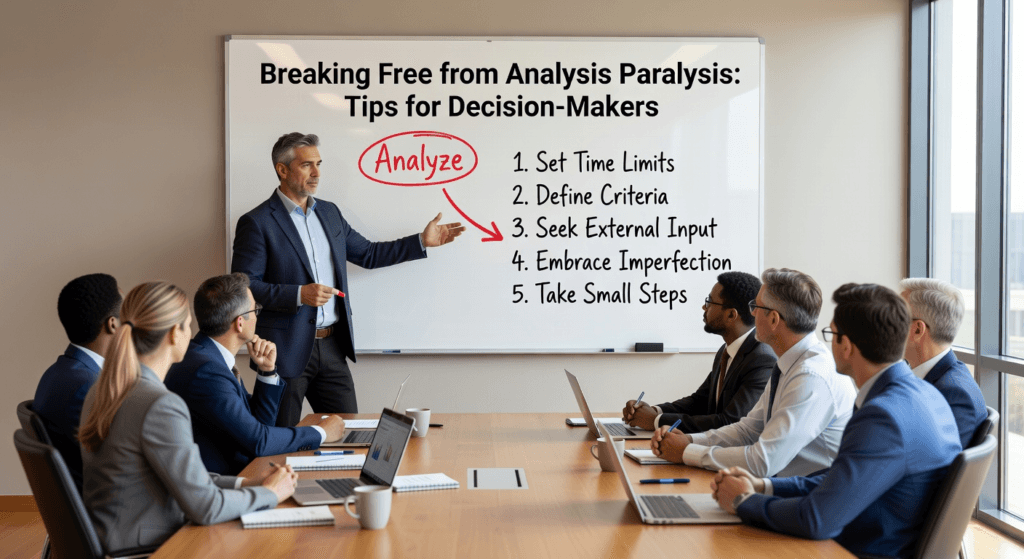
From experience, the following practices work across domains:
- Force clarity on necessity vs preference
- Time-box analysis explicitly
- Use the 70% rule as a default
- Ask: “Is this reversible?” before debating endlessly
- Make someone accountable for the decision
These are not tools or processes.
They are leadership behaviours.
One hidden cost of analysis paralysis is the number of hours consumed in inconclusive meetings. See exactly what those delays are costing your project in real money with the Meeting Cost Calculator — it puts a number on time lost to indecision before it becomes a budget problem.
Frequently Asked Questions
What is analysis paralysis in project leadership?
Analysis paralysis is when teams or leaders delay decisions by continuing to gather information, explore options, or seek consensus — long past the point where additional analysis adds value. In my experience it is almost always a leadership problem, not a data problem. The information needed to decide is usually available. What is missing is the willingness to own the decision.
What is the 70% rule in decision making?
The 70% rule is a practical decision framework — if you have roughly 70% of the information needed, decide rather than wait for certainty that may never arrive. Waiting for 100% clarity in complex project environments is not risk-free. It is actively risky. Delays compress schedules, reduce options, and force worse decisions later under greater pressure.
How do you distinguish between reversible and irreversible decisions?
Ask one question: if this decision turns out to be wrong, can it be corrected at manageable cost? If yes, it is reversible — decide quickly and adjust if needed. If no, it warrants more careful analysis. The problem is that most teams treat reversible decisions as irreversible, which is one of the most reliable ways to stall a project unnecessarily.
Why do capable teams still suffer from analysis paralysis?
Because capability and decisiveness are different things. Experienced teams can always find more options to consider, more risks to model, more scenarios to analyse. Without a leader willing to impose a decision framework and call time on analysis, thinking never converts into action. The more capable the team, the easier it is to over-analyse — because there is always more to explore.
What does decisive leadership look like in practice?
It means creating clear decision frameworks, separating facts from preferences, accepting calculated risk, and owning outcomes rather than deferring responsibility. Decisive leaders make decisions visible, time-box analysis explicitly, and protect momentum deliberately. It does not mean reckless action. It means refusing to let the fear of imperfect information become a reason for no action at all.
How does analysis paralysis affect project outcomes?
Directly and significantly. Schedule compression, reduced optionality, forced decisions under crisis conditions, and erosion of team confidence all follow from sustained decision delay. In execution-heavy environments, delayed decisions are rarely neutral — they actively create the problems that leaders were trying to avoid by waiting.
Final thought
Analysis paralysis is rarely about data.
It is about fear, diffusion of responsibility, and lack of decision frameworks.
Leadership exists precisely to address these moments—when clarity is incomplete, pressure is real, and progress still matters.
Perfect decisions are rare.
Delayed decisions are common.
In complex environments, progress beats perfection—and leadership is what makes progress possible.
Explore more practitioner insights
For more experience-led perspectives on leadership, execution, and decision-making under pressure, explore project leadership and execution insights on Projifi:
👉 https://projifi.blog/


