Why this article exists
Statutory approvals are one of the most misunderstood risk areas in EPC contracting.
They are treated as routine. Budgeted optimistically. And far too often, handed to the main contractor without either party fully understanding what that means in practice.
This article is about what happens when that misunderstanding meets reality.
In brief
When statutory approvals sit inside the main contractor’s scope on an LSTK contract, the project inherits a risk it cannot quantify, cannot control, and cannot recover from easily. The only real derisking strategy is to remove these approvals from the critical path entirely — before the contract is signed.
How these problems start: the sales process
In my experience, the root cause of permit-related delays is rarely on site.
It starts much earlier — in the sales process.
Commercial teams under pressure to win LSTK contracts often include statutory approvals in the main contractor’s scope without fully understanding the practical implications. The nuances involved — regulatory timelines, authority workload, seasonal availability, drawing query cycles — are either overlooked or underestimated.
The scope gets signed. The clock starts. And the project inherits a risk nobody properly priced.
This is closely connected to how tendering decisions are made under pressure — something I have written about separately in the Tendering Strategy Guide, which covers how bid-stage decisions shape execution outcomes long before a project begins.
A pattern I have seen in practice
On one EPC project — the details of which I will keep anonymised — statutory approvals for construction drawings were placed squarely within the main contractor’s scope.
Initially, the process appeared manageable.
Then the project ran into a prolonged festivity period.
Approving engineers within the statutory bodies became largely unavailable. Query resolution on construction drawings slowed to a near standstill. Construction permits that were expected within weeks stretched into months.
Municipal inspections during civil construction faced similar delays — inspectors were simply not available at the frequency the schedule assumed.
The contract, unfortunately, was not clear on where this responsibility sat. Was it the employer’s risk or the main contractor’s? Nobody had a clean answer.
And that ambiguity — more than the delays themselves — is what made recovery so difficult.
The core problem with accepting statutory approvals in LSTK scope
There is a fundamental mismatch between the nature of LSTK contracting and the nature of statutory approvals.
LSTK contracts are built on the premise that the contractor controls the outcome. Fixed lump sum. Fixed timeline. Defined deliverables.
Statutory approvals operate on none of those terms.
You cannot instruct a regulatory body to move faster. You cannot recover schedule by throwing resources at an approval queue. You cannot price the impact of a festivity period, a staff shortage, or a regulatory backlog with any real accuracy.
When you accept these approvals into your LSTK scope, you are accepting a risk whose quantum you cannot know at tender stage.
That is not a commercial decision. It is a gamble.
Mistake #1: Pricing statutory approvals like internal activities
The first mistake happens at tender.
Statutory approvals get treated like internal deliverables — assigned a duration, placed on the programme, and priced accordingly.
But they are not internal deliverables. They are external dependencies.
The difference matters enormously under a fixed-price contract.
An internal activity that slips can be recovered through overtime, resequencing, or additional resources. A statutory approval that slips cannot be recovered through any of those methods.
When the approval delays, everything downstream delays with it — and the contractor carries the full commercial consequences.
Mistake #2: Leaving contractual responsibility ambiguous
The second mistake is contractual ambiguity.
When the contract does not clearly define who owns the statutory approval risk — the employer or the main contractor — disputes become inevitable the moment delays occur.
Both parties default to protecting their own position. Claims are raised. Counterclaims follow. Legal costs accumulate.
Meanwhile, the project sits largely idle, waiting for a resolution that should have been defined before the contract was executed.
Clarity at contract stage costs very little. Ambiguity at execution stage costs a great deal.
This ambiguity does not just affect approvals. It is one of the core reasons risks derail projects — unclear ownership creates gaps that widen under pressure.
Mistake #3: Assuming regulatory timelines are predictable
Statutory bodies operate on their own schedules.
Festivity periods, internal reorganisations, staff shortages, policy changes, and query volumes all influence how quickly approvals move. None of these factors are within the contractor’s control, and few of them are visible at tender stage.
Assuming best-case timelines for regulatory approvals is one of the most reliable ways to build schedule risk into your project from day one.
The commercial spiral nobody wants to talk about
When statutory approval delays hit an LSTK project, the immediate problem is schedule.
The deeper problem is money.
And the deepest problem is what happens when both parties sit across a table trying to agree on who pays for what.
In my experience, this is where projects go from difficult to damaging.
Prolongation costs begin accumulating the moment construction stalls.
Site establishment costs continue regardless of progress:
- Temporary facilities maintained at full cost
- Site management and supervision teams on full payroll
- Equipment on standby — rental clocks running
- Subcontractors claiming for idle time and extended preliminaries
- Material storage costs mounting
- Labour either idling on site or demobilised and later remobilised at premium rates
These costs are real, significant, and entirely disconnected from any productive output.
The employer’s position is equally uncomfortable.
From the employer’s perspective, they are watching costs rise on a project delivering nothing visible. Capital is deployed. Returns are delayed. Financing costs accumulate. Operational start dates slip.
The employer’s instinct — entirely understandable — is to resist paying for delays they did not cause and did not anticipate.
And so begins the spiral.
The negotiation spiral
What follows statutory approval delays on ambiguously contracted LSTK projects is almost always the same pattern:
The contractor submits a prolongation claim — additional time and money for delays outside their control.
The employer disputes it — arguing the contractor accepted the approval risk in scope.
Both parties retreat to their legal and commercial teams.
Weeks of correspondence follow. Then months.
Meanwhile:
- The project either stalls further or proceeds at risk
- Relationships deteriorate
- Senior management time gets consumed by commercial disputes rather than delivery
- Legal costs accumulate on both sides
- Writeoffs begin appearing quietly in project accounts
Eventually, a negotiated settlement emerges — typically somewhere neither party is satisfied with.
The contractor recovers less than they claimed. The employer pays more than they wanted. Both sides absorb costs that were entirely avoidable.
The most damaging outcome is not financial.
It is reputational.
The contractor becomes known as difficult to work with. The employer becomes known as a client who does not honour obligations. Future relationships — bids, referrals, partnerships — are quietly affected.
This reputational damage follows a similar pattern to what happens when subcontractor relationships break down under delivery pressure — trust, once lost, is extremely difficult to rebuild. I have written about this dynamic in detail in Building Trust in EPC Projects.
All of this traces back to a scope decision made under commercial pressure during the sales process.
What a well-structured contract looks like instead
Mature EPC organisations handle statutory approval risk with explicit contractual language:
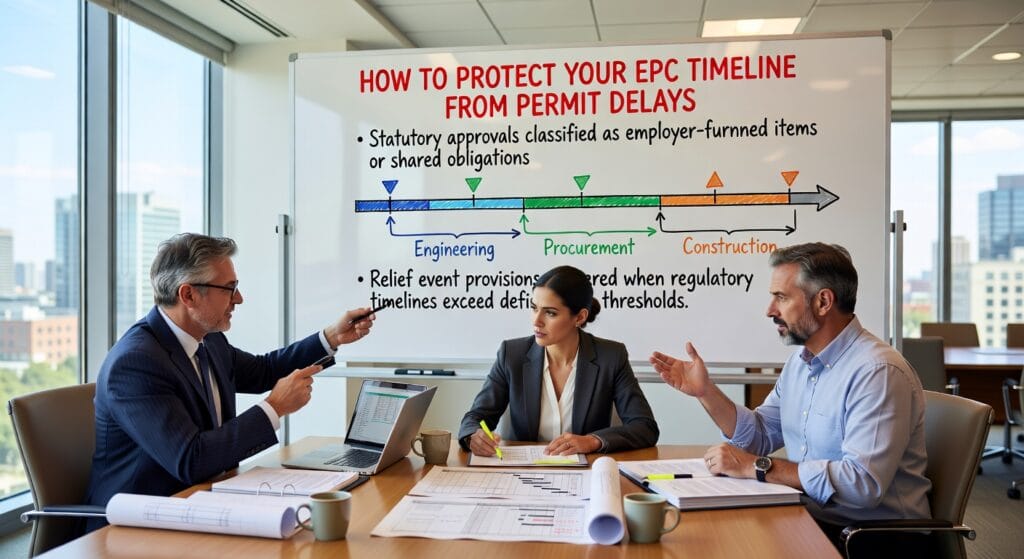
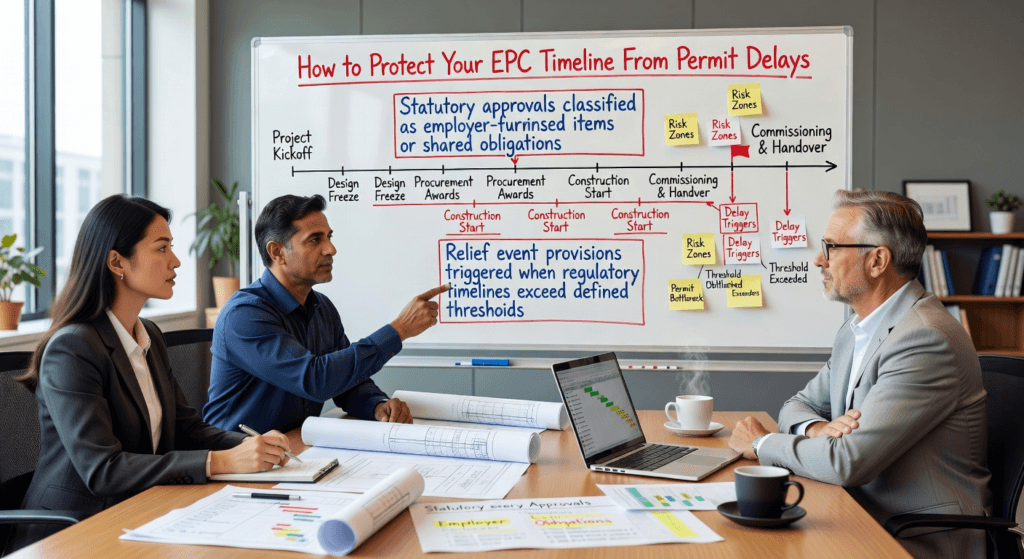
- Statutory approvals classified as employer-furnished items or shared obligations
- Relief event provisions triggered when regulatory timelines exceed defined thresholds
Everything else is negotiable — but these two provisions are non-negotiable if you want to protect your project from the commercial spiral described above.
The only real derisking strategy
In my experience, there is one approach that genuinely protects the contractor:
Remove statutory approvals from the critical path before the contract is signed.
This means:
- Identifying all statutory approval dependencies at tender stage — not during mobilisation
- Clearly defining in the contract whether these are employer responsibilities or contractor responsibilities
- If they remain in contractor scope, ring-fencing them with explicit schedule float, contractual protections, and relief event provisions
- Never allowing a statutory approval milestone to sit on the critical path of an LSTK programme without contractual protection against delays outside the contractor’s control
This is not about avoiding responsibility. It is about pricing and contracting intelligently for risks you cannot control.
Sound procurement strategy plays a critical role here — how you structure scope, responsibilities, and commercial terms at the procurement stage determines how much execution risk you carry. The Procurement Strategies guide covers this in more depth.
What the sales process needs to understand
The decisions that create permit-related delays are almost always made before the project starts.
Sales teams need to understand that including statutory approvals in LSTK scope without proper risk assessment is not competitive positioning — it is unpriced liability.
The questions that should be asked at bid stage:
- Which approvals are required and by which authorities?
- What are realistic timelines based on regional and seasonal patterns?
- Who owns the risk if timelines slip?
- What contractual protections exist if the approval process delays construction?
If these questions do not have clear answers at tender, the scope is not ready to be priced.
Frequently Asked Questions
Why do statutory approval delays cause such serious problems on LSTK contracts?
LSTK contracts assume the contractor controls the outcome — fixed lump sum, fixed timeline, defined deliverables. Statutory approvals operate on none of those terms. When approvals slip, the contractor carries commercial consequences for delays entirely outside their control, often without contractual protection.
Who should own statutory approval risk on an EPC project — the employer or the contractor?
In most well-structured contracts, statutory approvals are classified as employer-furnished items or shared obligations. The employer typically has stronger relationships with regulatory authorities and greater ability to escalate. Placing this risk entirely with the main contractor on a fixed-price basis creates unpriced liability at tender stage.
What is a relief event provision and why does it matter for permit delays?
A relief event provision is a contractual mechanism that entitles the contractor to time and cost relief when specific events outside their control cause delays. Including permit approval delays as a defined relief event protects the contractor from prolongation costs they cannot recover through their own actions.
How do prolongation costs accumulate during permit delays?
When construction stalls waiting on approvals, site costs continue regardless of progress — supervision, equipment standby, subcontractor preliminaries, material storage, and labour costs all accumulate without productive output. These costs become the subject of claims and disputes when contractual responsibility is ambiguous.
What is the single most effective way to manage statutory approval risk on EPC projects?
Remove statutory approvals from the critical path before the contract is signed. Identify all approval dependencies at tender stage, define contractual ownership clearly, and ensure relief event provisions are agreed before execution begins. Prevention at contract stage costs far less than dispute resolution during delivery.
Final thought
Statutory approvals will always be part of EPC projects.
The question is not whether they create risk — they always do. The question is whether that risk is understood, priced, and contractually protected before the project begins.
Projects that get this right protect their timelines, their margins, and their client relationships.
Projects that get it wrong find out the hard way — usually during a festivity period, with construction idle, and a contract that offers no clear answer on who is responsible.
Plan the risk before you sign the contract. Not after.
If this resonated, subscribe to Projifi — practitioner insights for complex projects that must deliver.


