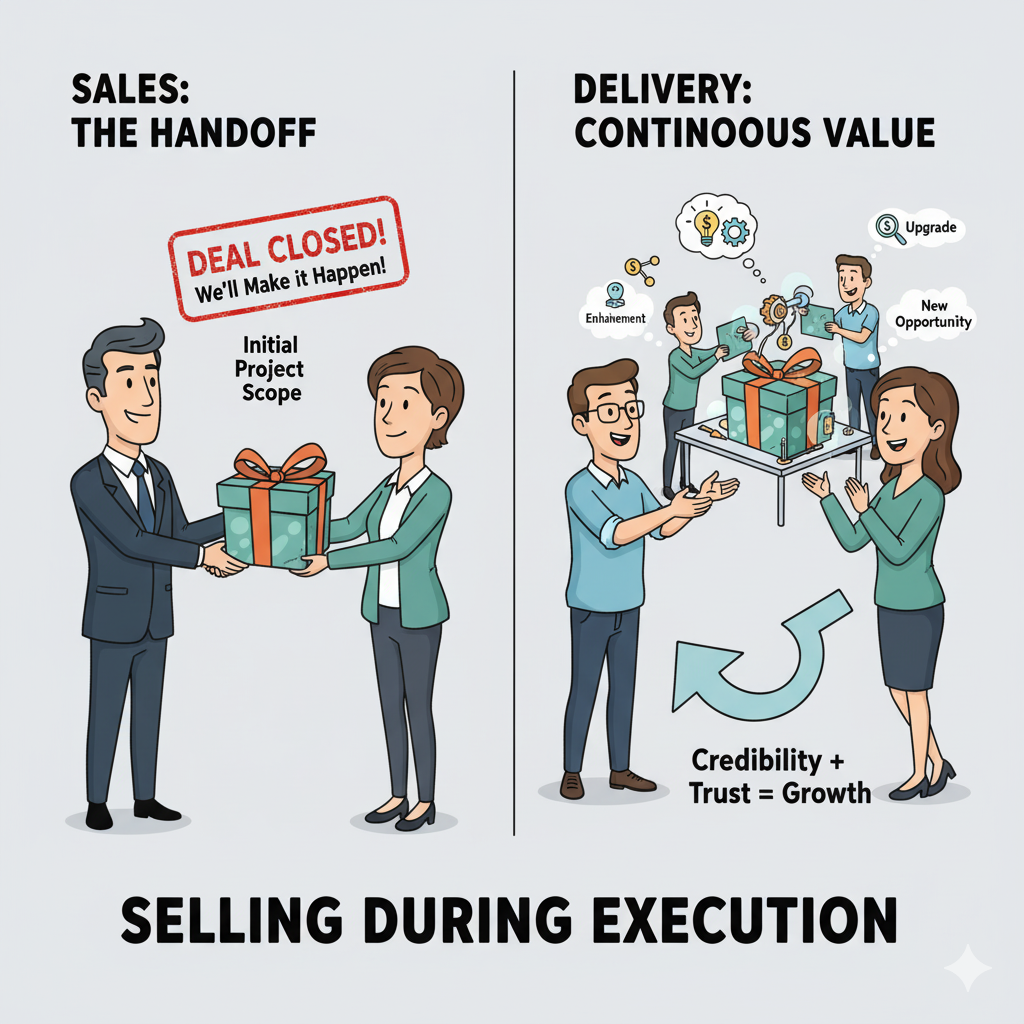
In EPC and heavy engineering (cement plants, oil and gas facilities, power, metals, and large industrial builds), project sales is often treated like a finish line: bid, negotiate, win, hand over to execution. But experienced contractors know the opposite is true.
The moment a contract is signed is when the highest-leverage sales work begins because execution is where outcomes are shaped, trust is earned, and the next tranche of revenue is created.
In project industries, the buyer is not purchasing a product. They are buying schedule certainty, performance guarantees, safety, operability, and risk transfer. Those promises are tested not in the proposal but on site, during engineering, procurement, construction, commissioning, and ramp-up.
That is why the strongest EPC firms embed a continuous sales mindset into project delivery: not selling more at any cost, but systematically identifying and converting genuine client value into commercial outcomes such as variation orders, scope growth, service add-ons, O and M extensions, debottlenecking packages, and repeat projects.
Why After-Award Sales Matters More in EPC Than in Most Industries

EPC contracts whether lump sum turnkey, EPCM, reimbursable, or hybrid are living systems. Industrial projects evolve due to permitting changes, vendor constraints, constructability discoveries, interface clashes, and operational clarifications. Even when scope is frozen, reality produces deltas.
The question is whether those deltas become claims, conflict, and margin erosion or become structured opportunities that improve outcomes for the owner and the contractor.
A continuous sales approach during execution helps you:
- Convert field learnings into client-facing value improvements and paid scope.
- Protect schedule and margin through early alignment and disciplined change management.
- Build boardroom trust that leads to follow-on phases and new awards.
The Execution Team Becomes the New Frontline Sales Force

In heavy industry, the delivery team has a unique advantage over pre-award sales: proximity to truth. Project managers, engineering managers, construction managers, commissioning leads, and planners see the client’s real constraints operational, logistical, and political.
They also see what the owner’s team is struggling to coordinate: interfaces between OEMs, civil contractors, brownfield shutdown windows, HSE constraints, and start-up readiness.
When delivery teams are coached to recognize value creation moments, they naturally become trusted-advisor sellers. This is not about turning PMs into quota-carrying salespeople. It is about giving them a repeatable system to translate delivery insights into proposals the client welcomes because they reduce risk and increase project certainty.
Continuous sales mindset is most effective when it is designed as part of the operating system, not a side activity. See how to institutionalize it here:https://projifi.blog/
The Core Idea: Sales is Risk Reduction in Disguise
In cement, oil and gas, and heavy engineering, owners pay premiums to reduce uncertainty. The strongest post-award sales plays are risk-reduction plays that also generate revenue.
Examples include:
- Upgrading instrumentation packages to improve commissioning stability.
- Adding redundancy to utilities that protect plant availability.
- Digital progress tracking and earned value reporting that improves governance.
When positioned as a risk-reduction and performance-enhancement package, scope growth becomes an owner-friendly decision instead of a contentious negotiation.
Where Hidden Revenue Actually Comes From (EPC Reality)

Most execution-stage revenue opportunities fall into a few predictable buckets. Build your after-award sales radar around these categories.
1) Clarifications That Become Scope
Owners often realize late that included and required for operation are not the same thing. Typical examples:
- Tie-in spools, hot taps, and temporary bypass requirements.
- Heat tracing, insulation coverage, and cold-weatherization details.
- DCS integration work, networking, historian tags, and cybersecurity constraints.
- Hazardous area compliance items and documentation deliverables.
- Spare parts philosophies, special tools, and maintenance access modifications.
Delivery teams should log these as value gaps and propose solutions with clear operability, safety, and reliability benefits.
2) Constructability-Driven Redesigns
Site realities expose design assumptions. In brownfield oil and gas and cement upgrades, you may discover clashes, congested pipe racks, lifting constraints, or shutdown window conflicts.
A constructability improvement proposal can monetize what owners value most: time and certainty. Common levers include:
- Re-sequencing workpacks to protect critical path.
- Modularization and prefabrication to reduce site hours and HSE exposure.
- Skid packages and alternate routing to minimize rework.
If you can save weeks, the owner often perceives the value far above the incremental cost.
3) Supply Chain Constraints That Need Alternatives
Long-lead equipment disruptions create openings for value engineering: alternate OEMs, revised specs, different metallurgy, modular solutions, or parallel procurement strategies.
When the contractor proactively offers a compliant alternative, they do not just solve a problem. They build credibility and can monetize acceleration, reduced downtime risk, and improved commissioning readiness.
4) Change Orders Done Right (Not as a Fight)
In many EPC firms, change orders are treated as either a threat or a weapon. A mature contractor treats them as a service: early notice, quantified impact, options, and documented approvals.
That approach protects relationships and improves cashflow discipline, especially when working with large owner organizations and complex approval chains.
If you have related content on claims, change management, or project controls on Projifi Blog, link it here in your site navigation and embed it at the first mention of change orders and at the close of this section.
5) Commissioning, Start-Up, and Ramp-Up Packages
Owners underinvest in start-up readiness until late. Delivery teams can offer structured packages that directly affect plant performance:
- Commissioning management and systems completion planning.
- Training, SOP alignment, and start-up staffing augmentation.
- Spares optimization and reliability-centered maintenance kickoff.
- Performance test support, troubleshooting, and warranty management.
These add-ons are often easier to approve because they connect directly to ramp-up KPIs and availability targets.
Turning Delivery Insights Into Commercial Wins (A Simple System)

To operationalize continuous sales, you need a lightweight system that fits EPC delivery rhythms and reduces friction between site, engineering, and commercial.
Step 1: Capture Value Signals Weekly
Add a standing agenda item to the weekly project review: value signals. Examples include repeated client questions, delays due to missing information, interface confusion, field changes, and safety constraints.
Log them as hypotheses, not accusations, and assign an owner for validation.
Step 2: Convert Signals Into Options (Not Demands)
For each signal, develop 2 to 3 options:
- Baseline: do nothing, accept the risk and consequences.
- Improved outcome: recommended option with best value-to-risk reduction.
- Accelerated outcome: premium option for schedule compression or performance uplift.
Owners respond better to choices that clarify tradeoffs across cost, schedule, risk, and operability.
Step 3: Package the Proposal Like an Owner Decision Memo
Your internal proposal should read like a mini business case, not a technical dump. Include:
- Impact and benefits (schedule, safety, operability, reliability).
- Assumptions and exclusions that avoid later disputes.
- Required client inputs and interface responsibilities.
- A fast approval path and required signatories.
This avoids the commercial versus site tug-of-war and speeds sign-off.
Step 4: Build a Repeatable Approval Workflow
Many good ideas die in procurement loops. Create a standard variation workflow and a client-facing template set so approvals do not stall.
Standardization also protects margin because documentation becomes consistent and entitlement is easier to defend without escalation.
Roles and Responsibilities: Who Owns Post-Award Sales?
Continuous sales only works when responsibilities are explicit and coordinated. A practical ownership model looks like this:
Project Manager (PM)
Owns client relationship health, steering discussions toward outcomes, tradeoffs, and approvals. Ensures value proposals are aligned with the project narrative and not framed as surprises.
Engineering Manager
Owns technical alternatives, constructability improvements, and spec-compliant substitutions. Validates operability and maintainability impacts before proposals go commercial.
Commercial or Contracts Manager
Owns change documentation, entitlement logic, pricing structure, and claim avoidance through early alignment and disciplined notices.
Sales or BD (Account Owner)
Owns executive alignment and future pipeline while staying connected to delivery realities so the client experience on the current project strengthens the next award.
Common Failure Modes (And How Heavy Industry Can Avoid Them)

EPC organizations often sabotage post-award value creation in predictable ways. The fixes are mostly cultural and process-driven.
Failure Mode 1: Delivery Must Not Talk Commercial
If teams are punished for raising commercial topics, they stop surfacing value opportunities. Train teams on value-first framing: articulate the operational benefit before the price, and make the commercial path safe and repeatable.
Failure Mode 2: Change Orders Managed Too Late
Late notices become disputes. Establish early warning and impact range updates even when data is incomplete, then tighten the estimate as engineering and site facts mature.
Failure Mode 3: Silos Between Sales and Execution
In heavy engineering, the handover gap can destroy trust. Use a joint award-to-kickoff playbook with shared objectives and a unified client narrative, then maintain a single story from pre-award commitments through commissioning.
Practical Plays for Cement, Oil and Gas, and Heavy Engineering

Execution-stage value plays are most effective when they are specific to the asset type and linked to owner KPIs like availability, throughput, and ramp-up speed.
Cement Projects
- Debottlenecking packages for fans, ducts, cyclones, and material handling.
- Alternative refractory strategies to improve reliability and reduce downtime.
- Advanced process control readiness work tied to ramp-up KPIs.
Oil and Gas Facilities
- Brownfield tie-in optimization and shutdown minimization planning.
- Hazardous area compliance upgrades including documentation and equipment.
- Commissioning and pre-startup safety review support services.
Heavy Engineering, Metals, and Power
- Modularization and logistics optimization to protect schedule.
- Digital QA and QC packages for traceability and turnover acceleration.
- Reliability and maintainability improvements driven by field feedback.
Metrics That Prove the Continuous Sales Model Works
To keep this from becoming soft talk, measure what matters and publish it like any other delivery KPI:
- Change order cycle time from idea to approval.
- Net margin impact of approved variations versus dispute costs avoided.
- Client satisfaction at key milestones (engineering freeze, mechanical completion, performance tests).
- Repeat work rate (next phase, O and M, debottlenecking, new site award).
- Forecast accuracy for final cost and completion dates.
| Metric | What it reveals | Why it matters commercially |
|---|---|---|
| Change order cycle time | Speed of decision-making and documentation health | Faster approvals reduce cashflow friction and dispute probability |
| Variation margin impact | Quality of scoping and pricing discipline | Turns delivery insights into profitable growth instead of leakage |
| Milestone satisfaction | Trust and alignment at stress points | Predicts follow-on work and executive support |
| Repeat work rate | Client willingness to re-engage | Most valuable growth in project industries is repeatable and lower CAC |
| Forecast accuracy | Control maturity and realism | Improves governance credibility and reduces claim posture |
Leadership Behavior That Creates a Selling Culture in Delivery
Delivery teams will only adopt continuous sales if leaders reinforce it through visible behavior and incentives.
- Celebrate value wins that improved client outcomes, not just revenue.
- Provide simple commercial training: entitlement basics, documentation discipline, and client communication.
- Protect the team from blame when they surface risks early and propose options.
Key Takeaways: Sales is a Journey in EPC Too

In EPC, contract award is not the end of sales. It is the start of the most credible selling you will ever do.
Execution teams shape the client experience daily, and that experience determines whether you earn variations smoothly, protect margin, and win the next project.
If you embed a continuous sales mindset into engineering, procurement, and site delivery focused on risk reduction and performance, you do not just sell more. You deliver better outcomes and build the kind of trust that turns one award into a long-term industrial partnership.
References and Further Reading
PMI (Project Management): https://www.pmi.org/learning/library/change-management-projects-7196
Harvard Business Review (Customer Value/Relationships): https://hbr.org/1995/01/do-your-customers-keep-you-honest
Wharton (Customer Value/Strategy insights): https://knowledge.wharton.upenn.edu/article/customer-value/


