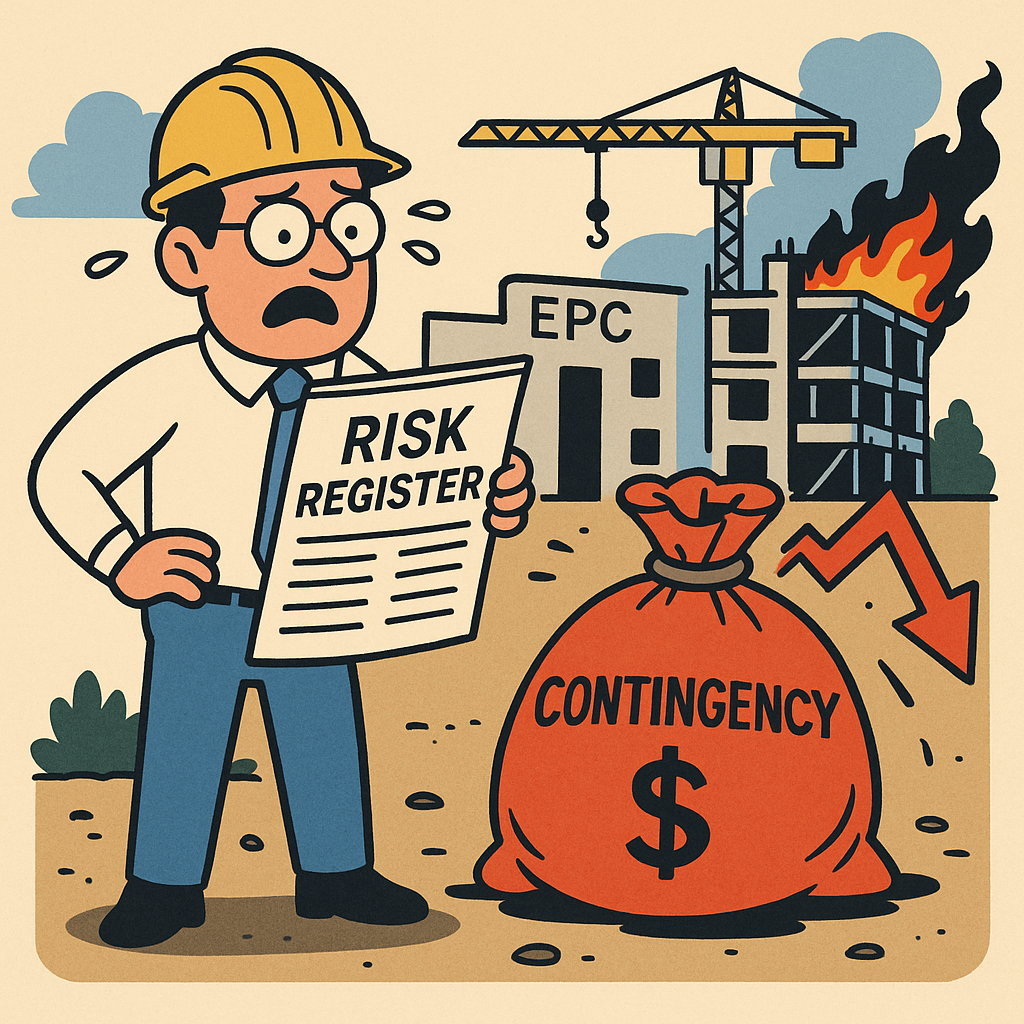
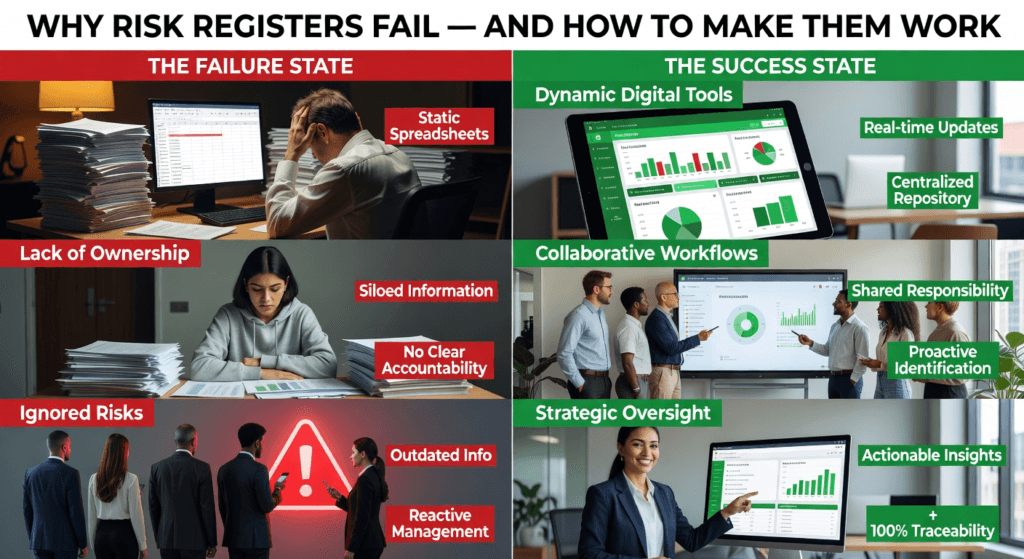
Risk registers are everywhere in EPC and large capital projects.
They are reviewed in meetings, updated religiously, colour-coded carefully, and stored neatly in shared folders.
On the surface, they signal discipline.
Yet projects still overrun.
Contingencies vanish faster than expected.
Escalations happen too late — or not at all.
The uncomfortable truth:
Why risk registers fail in projects is not about ignoring risk. It’s about tracking risk without structural decision logic.
They create visibility.
They rarely create control.
This disconnect is precisely why risk registers fail in projects repeatedly — not because teams ignore risks, but because the structure does not force decision-making under financial constraints.
The Illusion of Control — A Core Reason Why Risk Registers Fail in Projects
In many organizations, the risk register becomes a symbol:
- “We are managing risk.”
- “Everything is visible.”
- “Nothing is being ignored.”
But visibility is not actionability.
When everything is treated as a risk, nothing stands out as critical. Reviews become updates instead of decisions.
Over time, the register turns into a compliance artefact.
Practitioner Insight
Across multiple EPC programs, I’ve seen meticulously maintained risk registers coexist with accelerating cost exposure. The document was mature. The financial headroom was not.
That disconnect explains why risk registers fail in projects even when they appear structured.
The Real Structural Failure: No Link to Contingency
The deeper issue is rarely discussed.
Most registers track:
- Probability
- Impact
- Mitigation actions
Very few show:
- Remaining project contingency
- Cumulative residual risk exposure after mitigation
- Whether exposure is converging toward buffer limits
Without this linkage, the project has no early warning system.
It has hindsight.
A risk register must answer:
How much financial headroom remains relative to residual exposure?
When residual risk approaches contingency, escalation should trigger.
When it exceeds contingency, leadership decisions are required.
Without this, practical risk management during project execution becomes theoretical.
This principle aligns with disciplined financial control logic discussed here:
👉 https://projifi.blog/project-revenue-the-truth-about-recognition/
Why Risk Registers Fail in Projects: 5 Execution Patterns
1. Everything Is Logged, Nothing Is Filtered
Open capture is healthy.
But filtering rarely happens.
Critical and trivial risks coexist without hierarchy. Attention spreads thin. Urgency fades.
A risk register should be a decision shortlist — not a dumping ground.
2. Prioritisation Is Static
Many registers show high/medium/low ratings.
Few answer:
- Which risks threaten contingency today?
- Which require leadership attention now?
- Which are trending worse?
Execution risk control requires dynamic prioritisation.
3. Mitigation Actions Are Cosmetic
Common entries:
- “Monitor closely”
- “Follow up”
- “Discuss internally”
These do not reduce exposure.
If mitigation does not measurably lower probability or impact, it is symbolic.
Symbolic mitigation is one reason why risk registers fail in projects repeatedly.
4. Escalation Depends on Emotion
When escalation thresholds are undefined, escalation becomes political.
In some environments, hesitation to escalate early creates artificial stability — until exposure breaches contingency quietly.
Escalation must be structural, not emotional.
5. Risk Management Is Detached from Execution Rhythm
Registers reviewed monthly without linking to:
- Cost variance
- Schedule slippage
- Productivity trends
- Procurement delays
lose relevance.
Practical risk management during project execution requires integration into weekly control rhythms.
What a Functional Risk Register Looks Like
A strong register does less.
It:
- Captures broadly
- Filters aggressively
- Tracks only material exposure
- Quantifies residual risk honestly
- Links exposure directly to contingency
- Defines escalation triggers
It behaves like an early warning instrument.
Not a reporting template.
How to Fix It (Practitioner Framework)
Step 1: Separate Capture from Active Tracking
Encourage open identification.
Then filter ruthlessly.
Only risks that:
- Threaten objectives
- Have material exposure
- Can breach contingency
remain active.
Step 2: Quantify Residual Exposure Realistically
After mitigation, reassess.
Optimism bias is a silent destroyer of financial buffers.
Residual risk must reflect execution reality — not projected confidence.
Step 3: Link Residual Risk to Contingency
The register must visibly show:
- Available contingency
- Total residual exposure
When exposure trends toward headroom, escalation triggers automatically.
This transforms documentation into control.
Risk vs Contingency: The Control Instrument Most Projects Don’t Have
One of the clearest reasons why risk registers fail in projects is that teams never see cumulative exposure against real financial headroom in one place.
A simple structural tool can change that.
Instead of reviewing risks in isolation, create a live view that shows:
- Total approved project contingency
- Total residual risk exposure (after mitigation)
- Remaining available headroom
- Exposure trend (increasing or stabilizing)
This turns the register from a documentation sheet into an execution control dashboard.
Practitioner Insight
In large capital environments, I’ve observed projects reviewing 40–60 risks every month without ever asking one fundamental question:
“If all residual exposure materialises, do we still survive within contingency?”
When that question is finally asked—usually late—the exposure curve has already crossed the financial buffer.
The issue was never lack of risk identification.
It was lack of linkage.
What This Tool Should Visually Show
At minimum, your risk vs contingency view should include:
| Element | Why It Matters |
|---|---|
| Approved Contingency | Defines buffer limit |
| Residual Exposure | Shows real exposure after mitigation |
| Exposure % of Contingency | Triggers escalation thresholds |
| Trend Line | Detects acceleration risk |
When exposure reaches predefined thresholds (e.g., 70%, 85%, 100%), escalation should occur automatically.
No debate. No politics.
Structural triggers remove hesitation.
Build This Framework Practically
If you want a step-by-step breakdown of how to implement this control logic in your projects, read:
👉 How to Link Residual Risk to Project Contingency
This framework transforms documentation into decision logic.
And it directly addresses why risk registers fail in projects despite regular reviews.
Step 4: Define Escalation Thresholds in Advance
For example:
- Residual exposure ≥ 70% of contingency → Leadership review
- ≥ 85% → Executive discussion
- ≥ 100% → Buffer decision
Predefined triggers remove politics from escalation.
Step 5: Embed in Leadership Discipline
Risk management is not a PMO process.
It is leadership judgment under uncertainty.
This directly connects with:
Communication safety:
👉 https://projifi.blog/5-reasons-projects-fail-team-communication/
Trust-based execution culture:
👉 https://projifi.blog/why-trust-really-beats-supervision-in-epc-projects/
Without psychological safety, exposure surfaces late.
And late exposure is expensive exposure.
Common Pitfalls
- Maintaining large registers without filtering
- Confusing visibility with control
- Ignoring cumulative residual exposure
- Overestimating mitigation effectiveness
- Escalating based on personality instead of thresholds
- Treating contingency as comfort instead of buffer
These patterns repeatedly explain why risk registers fail in projects.
These recurring structural weaknesses explain why risk registers fail in projects even in organisations that believe they are following best practices.
Structured Takeaways
- A long register is not a strong one
- Visibility without contingency linkage is noise
- Residual exposure must be cumulative and visible
- Escalation must be structural
- Risk review must align with execution cadence
- Registers should trigger decisions — not meetings
If your risk register cannot tell you when to press the buzzer, it is not managing risk.
It is documenting hindsight.
FAQ
Why do risk registers fail in projects even when updated regularly?
Because updates without decision linkage do not reduce exposure. Registers must connect to contingency and escalation thresholds.
How many risks should be actively tracked?
Only material risks capable of breaching objectives or contingency.
What is the most critical structural improvement?
Link residual risk exposure directly to available financial headroom.
Is risk management a PMO activity?
No. It is a leadership discipline embedded in execution.
For more on the same topic you may also read the following:


