Insourcing is often positioned as a smart strategic move.
Leadership presentations frame it as a way to retain control, protect capital spend, and strengthen internal capabilities. On paper, the logic appears sound.
In execution, however, insourcing frequently delivers the opposite result. The actual insourcing costs are often far higher than anticipated.
Across large, capital-intensive projects, I have seen insourcing decisions quietly inflate budgets, weaken delivery performance, and—most damagingly—erode customer trust. These outcomes rarely show up immediately. Instead, they surface late, when recovery options are limited and reputational damage is already underway.
This article examines why insourcing fails so often—not in theory, but in real project environments.
In brief
Insourcing becomes a strategic trap when organisations confuse ownership with capability and internal alignment with value creation. The most costly mistakes emerge when competitive pressure disappears, accountability blurs, and decisions prioritise internal convenience over customer outcomes. Ultimately, hidden insourcing costs derail the project budget.
The hidden motivation behind many insourcing decisions
In many project organisations, the real driver behind insourcing is simple:
“If we source internally, the capital spend stays within the group.”
From a balance-sheet perspective, this can look attractive. However, it often bypasses a far more important question:
Does this decision improve delivery value for the end customer?
When that question is not central, insourcing stops being a strategy and becomes an entitlement. The organization ignores the long-term insourcing costs in favor of short-term capital retention.
A pattern I have seen repeatedly in capital projects
On several large capital projects, I’ve seen organisations force insourcing through their own subsidiaries, driven by the belief that capital expenditure should not flow outside the group.
Initially, the intent appeared reasonable.
However, once subsidiaries realised their order books would be filled automatically, competitive pressure disappeared. Delivery performance declined. Commercial discipline weakened. Prices increased. Terms were dictated rather than negotiated.
Over time, these internal suppliers began to behave like monopolies rather than partners—while the primary project organisation carried the execution risk. The financial insourcing costs spiraled without immediate detection.
The most damaging consequence was not financial.
It was reputational.
From the customer’s perspective, there was no visible value addition. Delays increased. Responsiveness dropped. Costs rose. Internal capital recycling meant nothing to them.
Eventually, goodwill eroded. And when issues surfaced, the customer did not blame the subsidiary. They blamed the primary organisation.
The situations described are anonymised patterns observed across multiple projects and organisations.
Mistake #1: Assuming internal suppliers behave like market vendors
The first mistake is believing that internal suppliers will perform like external ones.
They rarely do.
Without competitive pressure:
- Urgency fades
- Pricing discipline weakens
- Delivery accountability softens
Markets enforce performance. Mandates do not.
Unless internal suppliers face the same commercial and delivery consequences, insourcing creates complacency rather than efficiency. This complacency is a primary driver of hidden insourcing costs.
Mistake #2: Confusing control with competence
Many leaders equate insourcing with control.
In practice, control does not equal capability.
Owning a subsidiary does not guarantee:
- The right skills
- The right capacity
- The right execution maturity
When organisations insource without validating capability, they internalise risk while assuming safety. This mistake often surfaces late—when schedules are tight and alternatives are no longer viable—causing insourcing costs to skyrocket due to emergency fixes.
Mistake #3: Ignoring hidden cost and performance erosion
Insourcing often looks cheaper on spreadsheets.
What those spreadsheets fail to capture—and where the real insourcing costs hide—are these factors:
- Schedule slippage
- Rework and quality losses
- Expediting and firefighting costs
- Client dissatisfaction
- Reputation damage
These costs accumulate quietly. By the time leadership recognises them, the damage is already embedded.
This is why cost decisions must always be evaluated alongside delivery risk, not in isolation.
Mistake #4: Blurring accountability during execution
Insourcing frequently muddies accountability.
When problems arise, teams ask:
- Is this a supplier issue?
- Is this an internal coordination issue?
- Who actually owns the outcome?
Without clear commercial accountability, escalation loses its force.
External suppliers respond to penalties. Internal suppliers respond to politics.
That distinction becomes critical under pressure and often results in indirect insourcing costs related to management time and delay.
Mistake #5: Forgetting the customer sees no internal boundaries
Perhaps the most dangerous mistake is assuming customers care about internal structures.
They don’t.
Customers care about:
- Delivery
- Quality
- Commitments
- Outcomes
When insourcing costs degrade those outcomes, customers see it as self-serving behaviour, not strategy.
And once trust is lost, it is extremely difficult to regain.
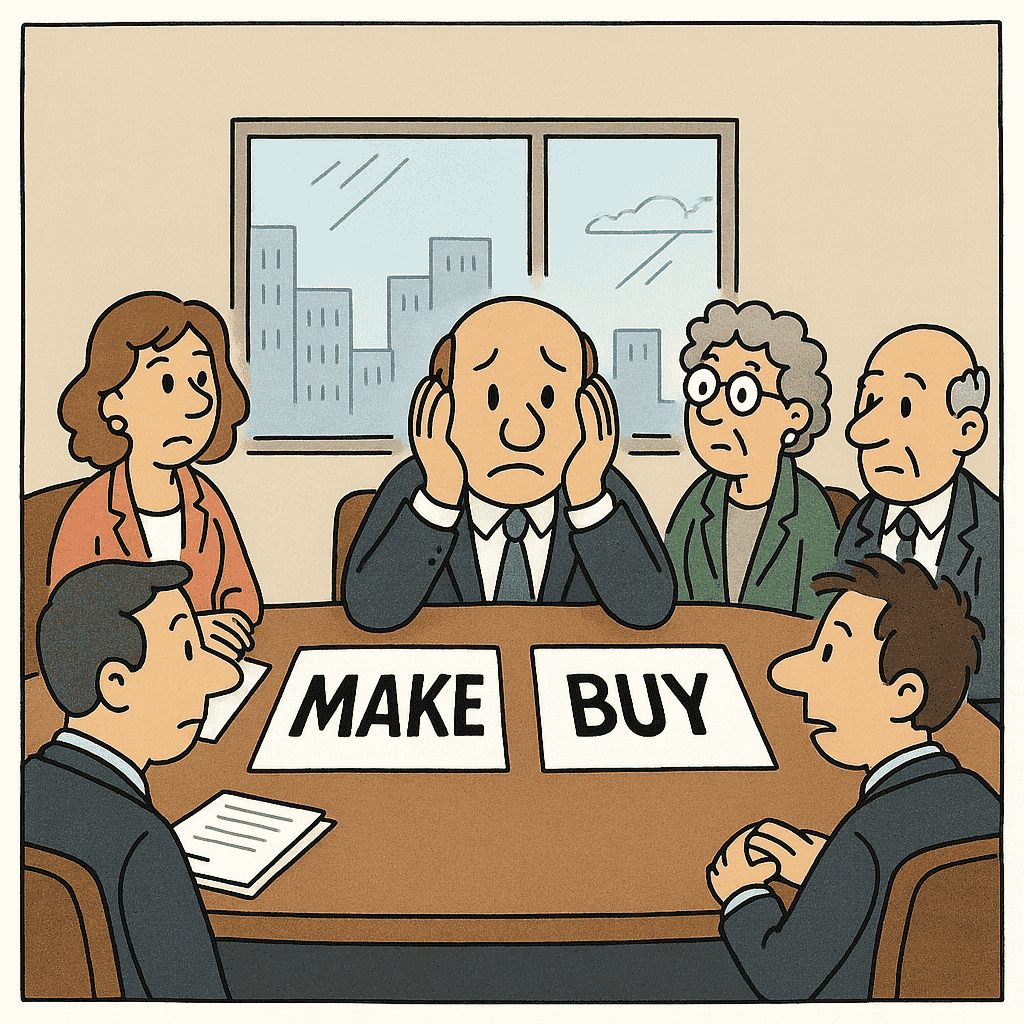
Build vs Buy: the question most teams avoid
The real question is not:
“Can we build this internally?”
It is:
“Should we?”
Effective build-vs-buy decisions consider:
- Capability maturity
- Market competitiveness
- Execution risk
- Client impact
- Long-term value creation
A useful external reference on structured build-vs-buy thinking: 👉 https://umbrex.com/resources/strategic-sourcing-playbook/make-vs-buy-outsourcing-decision-2/
This also ties closely to disciplined procurement strategy in projects: 👉 https://projifi.blog/procurement-strategies-maximize-value-savings/
Analyzing these factors helps you avoid the hidden insourcing costs that plague hasty decisions.
When insourcing actually makes sense
Insourcing can work when:
- Internal capability is genuinely best-in-class
- Performance benchmarks mirror the market
- Commercial accountability remains intact
- Customer value stays central
Without these conditions, insourcing is not a strategy—it is risk accumulation.
📌 If you’re leading projects, remember this
- Internal does not mean efficient.
- Control does not equal capability.
- Customers don’t care about internal politics.
- Poor insourcing destroys goodwill faster than cost overruns.
- Build vs Buy is a delivery decision, not a financial trick.
How to Evaluate Your Insourcing Decision: A Practical Checklist
Before committing to insourcing on your next project, run through this checklist. It takes less than ten minutes and can save months of execution pain.
Capability Assessment:
- Has the internal supplier delivered comparable scope before?
- Can they demonstrate measurable performance benchmarks?
- Do they have the right people available — not just theoretically, but confirmed and allocated?
Commercial Discipline:
- Will the internal supplier face real consequences for underperformance?
- Are pricing terms benchmarked against the open market?
- Is there a genuine alternative if performance deteriorates?
Customer Impact:
- Does this decision improve delivery outcomes for the end customer?
- Have customer-facing commitments been stress-tested against internal capacity?
- Would you make this same decision if the customer could see your internal discussions?
If you answer “no” to more than two of these questions, the potential insourcing costs are likely too high to proceed.
The organisations that insource successfully share one trait: they treat internal suppliers with the same commercial rigour they apply to external ones. Performance is measured. Accountability is enforced. Alternatives are always maintained.
Without that discipline, insourcing is not a strategy. It is a convenience disguised as one.
Final thought
Insourcing fails not because organisations try to build.
It fails because they build for themselves, not for the customer.
When internal convenience outweighs delivery value, execution suffers—and reputation follows. The true insourcing costs are paid in lost trust.
The most mature organisations understand this clearly:
They insource only where it strengthens delivery. Everywhere else, they let the market do its job.
FAQ
What is the main risk of insourcing in capital projects? The biggest risk is complacency. When internal suppliers face no competitive pressure, delivery performance weakens, insourcing costs rise, and customer trust erodes — often before leadership recognises the pattern.
How do you decide between insourcing and outsourcing? Evaluate three factors: capability maturity, commercial accountability, and customer impact. If your internal supplier cannot match market performance on all three, outsourcing is the stronger delivery choice to mitigate high insourcing costs.
Can insourcing ever work on large EPC projects? Yes — but only when internal capability is genuinely best-in-class, performance is benchmarked against the market, and commercial consequences for underperformance remain real and enforced.
If this resonated, subscribe to Projifi. Not just to read — but to interact.
Engage directly with the author, tap into lived delivery experience, and learn through cross-sharing with other experienced practitioners inside a growing, practitioner-led community.
That’s how judgment compounds — through experience, reflection, and conversation.


