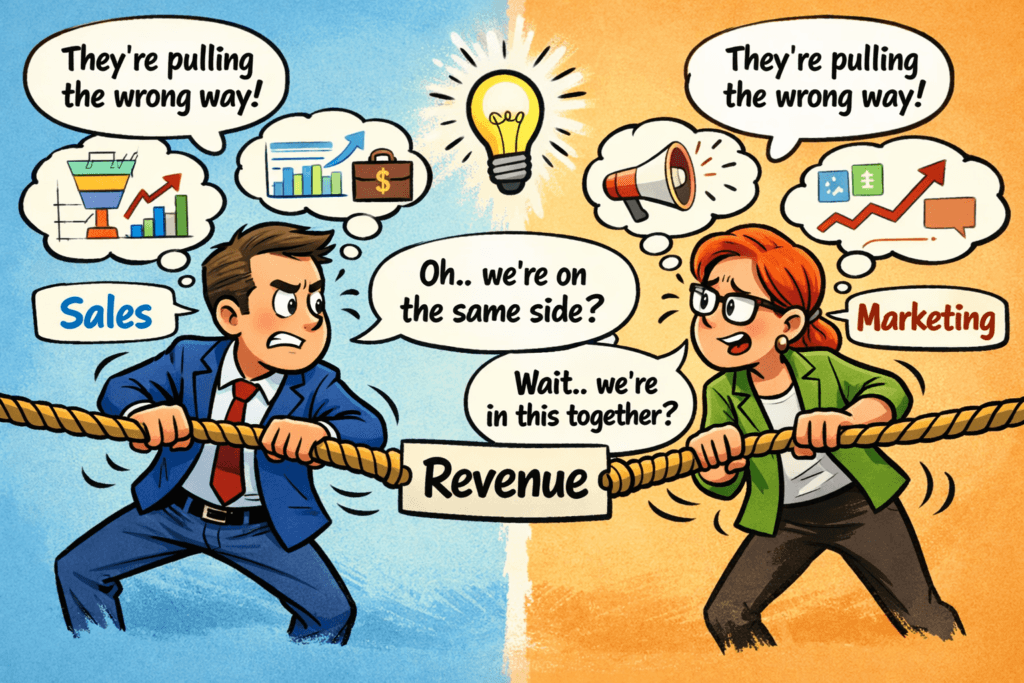

Marketing and sales alignment is one of the most discussed priorities in B2B leadership — and one of the most consistently failed. Workshops are run, CRM systems are configured, and handoff processes are redesigned. Yet in project-based organisations — EPC firms, heavy engineering, industrial services, infrastructure programs — the misalignment persists.
Most guides to marketing and sales alignment are built for short-cycle, transactional B2B environments. They optimise for MQL conversion rates, lead scoring thresholds, and CRM workflow compliance. These mechanics work in SaaS or volume-driven sales models. In project-based organisations with 12–36 month sales cycles, they are largely irrelevant.
This article presents a leadership-driven approach to marketing and sales alignment grounded in direct, first-hand experience from long-cycle, trust-driven project environments. It is written for senior leaders and business consultants working in or advising EPC, industrial services, and infrastructure organisations — where customer trust, not campaign volume, is the primary competitive currency.
Why Marketing and Sales Alignment Fails in Project-Based Organisations
The standard marketing and sales alignment playbook — shared CRM, agreed MQL definition, a service-level agreement between teams — assumes a relatively short feedback loop. A lead enters, progresses, converts or doesn’t, and the data informs the next iteration. The cycle is weeks, not years.
In project-based organisations, this assumption breaks down entirely. Sales cycles run 12 to 36 months. Customer relationships precede formal procurement by years. Early signals of intent — a plant manager mentioning an upcoming expansion, an operations lead asking informal questions about capability — arrive long before any RFQ or budget is confirmed.
In this environment, the marketing and sales alignment challenge is not about handoff mechanics. It is about how early customer intelligence is collected, shared, evaluated, and acted upon across a multi-year engagement cycle.
The Early Signal Problem
Marketing teams in project organisations are often closest to the customer at the earliest stage. They attend site visits, speak with plant-level personnel, and hear concerns, plans, and informal intent — months or years before anything becomes commercially visible.
| 🔶 PRACTITIONER INSIGHT In my experience, marketing teams are often closest to the pulse of the customer. They speak to people on the ground at customer plants. They hear early concerns, upcoming expansions, operational pain points, and informal intent — long before anything becomes a formal enquiry or RFQ. These early signals are not ‘sales-ready leads’. They are market intelligence. What I have seen repeatedly, however, is that these early signals are: • Taken lightly by sales teams • Deferred because they don’t look immediately actionable • Labelled as ‘low quality’ because they don’t convert quickly |
| Marketing Perspective | Sales Perspective | Outcome |
| Early signal = relationship investment | Early signal = unqualified lead | Signal dismissed |
| Customer shared informal intent | No RFQ present | Engagement deferred |
| Market intelligence has strategic value | Conversion probability is low | Trust opportunity lost |
Two Compounding Failures
1. Customer trust erodes. The customer opened a door — shared plans, expressed interest, signalled an upcoming decision. Delayed or fragmented engagement registers as unreliability. In project industries where personal credibility precedes contracts, this is rarely recovered quickly.
2. Marketing disengages. Marketing professionals who see their ground-level intelligence consistently dismissed stop investing in it. The intelligence loop that enables early-stage engagement breaks down entirely — and with it, the organisation’s ability to influence customers before competitors do.
Why Sales Teams Are Also Right — And Why That Makes Alignment Harder
Effective marketing and sales alignment requires understanding both sides of the tension. Sales teams are not wrong to filter early signals. In project-based businesses, many early conversations never mature into contracts. Time and pursuit capacity must be prioritised. Unilateral judgment by sales is not obstruction — it is operational necessity.
| 🔶 PRACTITIONER INSIGHT Sales teams operate under constant pressure to deliver outcomes. They will rightly argue: ‘Not every lead converts into an order.’ In project-based businesses, this is absolutely true. Many early conversations never mature into contracts. Time and effort must be prioritised carefully. The problem is not that sales filters leads. The problem is how early signals are filtered or dismissed — without joint evaluation, and without the relationship context that marketing has spent months developing. This is where alignment breaks down — not because either side is wrong, but because they optimise for different time horizons without a shared framework to moderate the trade-off. |
The Long-Term Cost of Poor Marketing and Sales Alignment
In transactional businesses, misalignment surfaces quickly in conversion data. In project-based organisations, the cost is invisible until it is severe — accumulating silently across multiple relationships over multiple years:
- Lost customer trust — inconsistent engagement signals organisational unreliability to buyers evaluating long-term partners
- Missed early influence — competitors who engage earlier shape the customer’s thinking, specification, and vendor shortlist before your organisation arrives
- Reduced repeat and negotiated work — customers who feel underengaged share less intelligence over time, reducing the informal conversations that drive scope offloading
- Silent pipeline erosion — relationships that never developed, or quietly shifted to a more consistently engaged competitor
What Effective Marketing and Sales Alignment Actually Looks Like
| 🔶 PRACTITIONER INSIGHT I have also seen the opposite — and the difference is unmistakable. In situations where sales and marketing were fully aligned very early, several things changed: • Early leads were treated as signals to be nurtured, not immediately qualified or discarded • Sales applied judgment instead of dismissal • Marketing stayed involved beyond lead generation • Customers experienced continuity instead of fragmented hand-offs The result was not just a deal. A large order was secured — followed by something more valuable: the client’s confidence increased, trust was established early, and additional scope was offloaded over time. This did not happen because every lead was chased. It happened because both teams respected early engagement and acted in sync. |
| What made this outcome possible: • Leadership established joint accountability before engagement began • Early signals were treated as relationship investments, not immediate conversion opportunities • Marketing remained involved through development and active pursuit stages • Sales applied contextual judgment rather than rigid qualification rules • The customer experienced organisational consistency, not departmental hand-offs |
A Leadership Framework for Marketing and Sales Alignment in Project Organisations
Based on experience in long-cycle project environments, effective marketing and sales alignment integrates four elements — each a leadership responsibility, not a process or technology configuration.
1. Joint Leadership Ownership — Not Parallel Reporting
| 🔶 PRACTITIONER INSIGHT In my experience, alignment works only when sales and marketing are anchored to a common leadership purpose. When both functions operate independently, misalignment becomes inevitable — each optimises for its own metrics. When there is a single leadership owner for sales and marketing together, moderation happens naturally: • Sales discipline tempers marketing enthusiasm • Marketing intelligence sharpens sales focus • Early signals are debated constructively rather than ignored This is not about hierarchy. It is about shared accountability for customer trust. |
| Independent Parallel Functions | Joint Leadership Ownership |
| Separate metrics, separate optimisation | Shared accountability for customer trust outcomes |
| Departmental protection of lead ‘ownership’ | Collaborative signal evaluation and joint decisions |
| Disagreements escalate upward and stall | Leadership moderation resolves trade-offs in real time |
| Marketing exits after lead handoff | Marketing remains engaged through conversion and beyond |
2. Early Signal Intelligence — Not Just Lead Qualification
A functional marketing and sales alignment framework must distinguish between signal maturity and signal dismissal. Not every early signal requires active sales pursuit — but every signal deserves a deliberate, jointly-evaluated response.
| Signal Type | Recommended Engagement Strategy |
| Immediate opportunity — RFQ, budget confirmed, timeline defined | Active pursuit — full sales engagement |
| Developing intent — expansion mentioned, pain points discussed, informal inquiry | Relationship investment — joint monitoring by both teams |
| Early awareness — customer learning, distant timeline, no formal intent | Patient observation — marketing maintains presence |
| Market intelligence — industry trends, competitor moves, technology shifts | Strategic input — inform positioning and content |
3. Shared Ownership of Customer Conversations
In most project organisations, marketing disappears the moment a lead is passed to sales. From the customer’s perspective, this creates a jarring discontinuity — the people they built rapport with are replaced by a sales team that lacks relationship context.
Effective marketing and sales alignment maintains continuity across the customer journey:
- Early stage: Marketing primary, sales informed and aware
- Development stage: Joint engagement with shared context
- Active pursuit: Sales primary, marketing actively supporting
- Post-sale: Both functions involved in trust compounding and scope expansion
4. Leadership Moderation — Not Process Escalation
| 🔶 PRACTITIONER INSIGHT From experience, effective alignment in project-based organisations includes: • Joint review of early leads — not to qualify immediately, but to understand context and intent • Shared ownership of customer conversations — marketing does not disappear once sales engages • Respect for market intelligence — early insights are treated as signals, not noise • Leadership moderation instead of escalation — differences are resolved through judgment, not turf battles When leadership avoids this responsibility, misalignment becomes structural — regardless of how many processes are implemented. |
| Process Escalation Approach | Leadership Moderation Approach |
| Disagreements escalate to senior leadership | Leadership facilitates joint evaluation |
| Decisions delayed while escalation resolves | Judgment applied in real time |
| Teams defend departmental positions | Teams explore context together |
| CRM rules determine engagement | Human judgment determines engagement |
Implementing Marketing and Sales Alignment: Three Practical Interventions
For leaders and consultants working in project-based organisations, these three structural interventions move alignment from concept to practice.
Weekly Signal Review Sessions
A standing weekly session where marketing presents early customer signals with relationship context, and sales provides perspective on engagement capacity and timing. The output is a joint decision — not a marketing recommendation that sales approves or rejects. Both teams own the outcome together.
This is not a pipeline review. It is an intelligence-sharing and judgment session. The discipline of conducting it weekly prevents early signals from ageing into irrelevance before they are evaluated.
Customer Engagement Continuity Protocols
Define explicitly how customer relationship continuity is maintained as engagement transitions from marketing-led to sales-led. This includes which marketing contacts remain involved and in what capacity, how customer relationship history is transferred and kept accessible, and how both teams maintain a unified voice in customer-facing communications.
Leadership Facilitation Cadence
Quarterly sessions where leadership reviews the quality of signal evaluation decisions made over the prior period. Were early signals appropriately invested in or dismissed? Did customer relationships develop as expected? Where did misalignment emerge, and what judgment was applied?
Why Marketing and Sales Alignment Matters More in Project Environments
In transactional B2B businesses, misalignment can often be corrected relatively quickly. The feedback loop is short — conversion data surfaces within weeks, and adjustments can be made.
In project-based organisations, the feedback loop is 12–36 months. Misalignment in how an early signal was handled in Q1 may not manifest as a lost opportunity until Q3 of the following year. By then, the customer has awarded work to a competitor who engaged earlier — and the connection between the original misalignment and the outcome is invisible in any dashboard.
This is why B2B marketing and sales alignment must be treated as a leadership priority in these environments — not a process optimisation project:
- Sales cycles are long — misalignment compounds over months or years before surfacing
- Trust precedes contracts — customers evaluate organisational reliability long before formal procurement begins
- Early engagement shapes outcomes — first impressions determine competitive position in shortlisting
- Relationships matter more than campaigns — personal credibility and consistency drive decisions in EPC and industrial environments
Ignoring early signals does not just lose a deal. It can lose an entire future pipeline — one relationship at a time, invisibly, over years.
FAQ: Marketing and Sales Alignment in Project-Based Organisations
What is marketing and sales alignment, and why does it matter in B2B?
Marketing and sales alignment is the process of ensuring both functions work toward shared customer outcomes rather than independent departmental metrics. In B2B project environments — particularly EPC and industrial organisations with long sales cycles — alignment determines whether early customer intelligence is acted upon or dismissed, whether customers experience organisational consistency or fragmented hand-offs, and ultimately whether trust compounds into repeat business or erodes through inconsistent engagement.
Why do standard marketing and sales alignment frameworks fail in EPC organisations?
Standard frameworks are built for short-cycle, transactional B2B environments. They optimise for CRM workflows, MQL definitions, and lead handoff speed — mechanisms that are largely irrelevant in project environments where sales cycles run 12–36 months and customer trust builds over years. Without joint leadership ownership, sales and marketing optimise for different time horizons without a framework to moderate the trade-offs.
How does leadership-driven alignment differ from CRM-based alignment?
CRM-based alignment optimises the process layer — workflow automation, lead scoring, handoff mechanics. Leadership-driven alignment addresses the judgment layer: how early customer signals are evaluated, which relationships deserve investment, and how trade-offs between short-term conversion and long-term trust are resolved. In project-based environments, the judgment layer determines outcomes far more than the process layer.
What are early customer signals, and how should they be handled?
Early customer signals are market intelligence gathered before formal RFQs or budget confirmation: mentions of upcoming expansions, operational pain points, technology interest, and informal relationship-building conversations. In project-based environments, these signals appear months or years before contracts materialise. A functional marketing and sales alignment framework treats them as relationship investments requiring joint evaluation — not automatic dismissal.
What is the long-term cost of poor marketing and sales alignment?
In project-based organisations, misalignment costs accumulate invisibly as lost customer trust, missed early influence, reduced repeat and negotiated work, and competitors who entered conversations first. In long-cycle environments where trust compounds into scope offloading and repeat business, consistent misalignment can eliminate entire future pipelines — not as failed deals, but as relationships that never developed.
How should consultants approach marketing and sales alignment in project organisations?
Consultants advising project-based organisations should focus on three structural interventions: establishing joint leadership ownership over both functions; implementing weekly signal review sessions where early intelligence is evaluated jointly; and defining customer engagement continuity protocols that prevent the fragmented hand-offs customers experience as organisational dysfunction. The most common mistake is recommending CRM or process improvements as the primary solution — leadership accountability and judgment quality matter far more.


