
Why this article exists
Many project managers work harder than they should — not because projects demand it, but because they unknowingly inherit other people’s problems.
Deadlines slip. Stress rises. Decisions bottleneck. Teams wait.
When you look closely, the issue is rarely lack of effort.
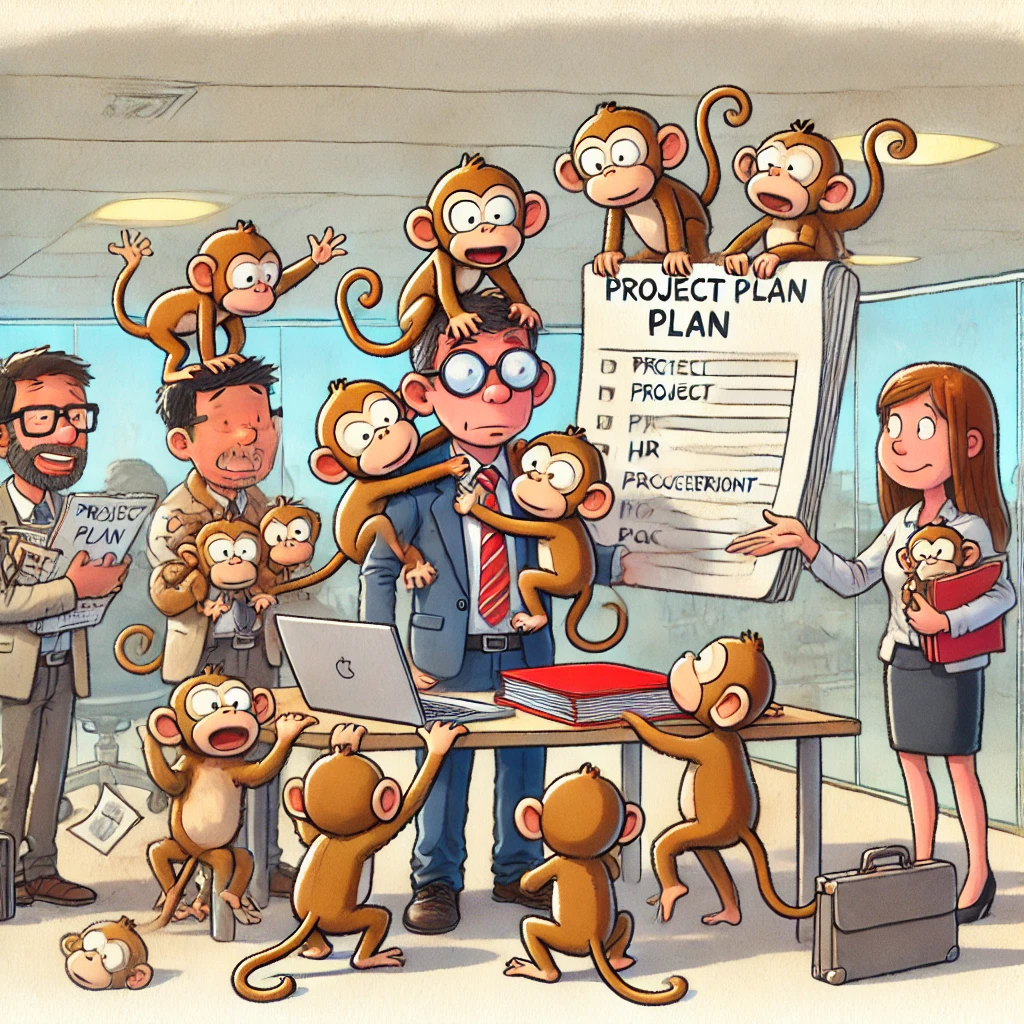
It is the monkey management trap — where problems quietly climb onto the project manager’s back and stay there.
This article explains how that happens, why it is dangerous, and how to end it.
In brief
Monkey management occurs when project managers take ownership of problems that belong to others. Instead of enabling teams to solve issues, they absorb them. Over time, this creates overload, weak accountability, slow decisions, and project failure. Ending the trap requires clarity on ownership, discipline in delegation, and the courage to let responsibility stay where it belongs.
What “monkey management” really means
In simple terms, a “monkey” is a problem.
Monkey management happens when:
- Someone brings a problem to you
- You take it over instead of sending it back with ownership
- The problem now lives on your desk
The original owner walks away relieved.
You walk away heavier.
At first, this feels like leadership. In reality, it is misplaced accountability.
How monkeys silently migrate to project managers
The transfer is rarely explicit.
It often sounds like:
- “Can you just take this up?”
- “You’re better positioned to handle it.”
- “This needs senior attention.”
- “I’ll wait for your direction.”
Each time you accept without clarifying ownership, a monkey jumps.
Over time, project managers become:
- Decision bottlenecks
- Issue collectors
- Escalation points for everything
This is unsustainable.
Why project managers fall into this trap
1. A desire to be helpful
Project managers are problem solvers by nature. Saying “I’ll handle it” feels productive.
Unfortunately, solving the problem yourself often prevents the system from learning.
2. Fear of delays
It feels faster to fix the issue personally than to push it back.
In the short term, it may be.
In the long term, it slows everything down.
3. Lack of clear role boundaries
When responsibilities are fuzzy, problems naturally drift upward.
Without clear ownership, monkeys roam freely.
4. Cultural habits
Some organisations reward fire-fighting more than prevention.
In such environments, people learn:
“If I push the problem up, it disappears.”
The cost of monkey management in projects
Monkey management does not fail loudly.
It fails quietly.
Its impact shows up as:
- Decision fatigue
- Burned-out project managers
- Disengaged teams
- Slower response times
- Poor accountability
Eventually, projects stall—not because problems exist, but because one person is carrying too many of them.
This also links closely to why communication and escalation break down:
👉 https://projifi.blog/5-reasons-projects-fail-team-communication/
Practitioner Insight
In over two decades of delivering complex capital and EPC projects, the most overloaded project managers I’ve encountered were not the weakest ones — they were often the most capable. Their competence made them a magnet for other people’s problems. The moment they started asking “who owns this?” instead of “I’ll handle it” — their teams grew, decisions spread out, and projects accelerated. The shift was not a management technique. It was a mindset reset about what leadership actually means.
The difference between support and ownership
Here is the critical distinction:
- Support: Helping someone think, decide, or act
- Ownership: Being responsible for the outcome
Project managers should provide support, not absorb ownership for others’ problems.
When you own everything, no one else owns anything.
How to stop monkeys from landing on you
1. Clarify ownership immediately
When a problem is raised, respond with:
- “Who owns this?”
- “What do you propose?”
- “What decision are you asking for?”
These questions send the monkey back—without confrontation.
2. Keep the monkey with the right owner
Instead of saying:
“I’ll take care of it”
Say:
“You own this. I’ll support you.”
That single sentence changes behaviour.
3. Avoid rescuing too quickly
Let people struggle a little.
Struggle is not inefficiency.
It is learning.
Rescuing teams repeatedly trains dependency.
4. Define escalation, not abdication
Escalation should:
- Clarify constraints
- Remove blockers
- Enable decisions
It should not transfer responsibility permanently.
This is closely related to leading without formal authority:
👉 https://projifi.blog/project-manager-without-authority-lead-anyway/
5. Protect your attention deliberately
Your attention is finite.
Every monkey you carry reduces your ability to:
- See systemic risks
- Think ahead
- Lead effectively
Good project managers manage attention, not just tasks.
Managing your attention starts with managing your time. If your project meetings are eating your focus, see how much they’re really costing with the Meeting Cost Calculator — it puts a real number on time lost to inefficient escalation and status theatre.
What healthy project ownership looks like
In well-functioning teams:
- Problems are raised with proposed solutions
- Decisions are made at the lowest competent level
- Escalation is purposeful, not habitual
- Accountability stays visible
Trust replaces supervision, and progress accelerates:
👉 https://projifi.blog/why-trust-really-beats-supervision-in-epc-projects/
📌 If you’re a project manager, remember this
- Every problem has an owner — make it explicit
- Helping is not the same as taking over
- Monkeys move when boundaries are unclear
- Short-term rescue creates long-term dependency
- Your role is to enable ownership, not replace it
Final thought
Monkey management feels productive.
Until it isn’t.
Projects don’t fail because problems exist.
They fail because ownership collapses under well-intentioned leadership.
The moment you stop collecting monkeys, teams step up, decisions spread out, and projects move again.
Leadership is not about carrying every problem.
It is about making sure every problem has a place to live.
What is monkey management in project management?
Monkey management is when a project manager absorbs problems that rightfully belong to team members or other stakeholders. The term comes from the idea that each unsolved problem is a “monkey” sitting on someone’s back — and poor delegation habits allow those monkeys to silently jump from their rightful owners onto the project manager’s shoulders. Over time this creates decision bottlenecks, burnout, and weak team accountability.
Why do project managers fall into the monkey management trap?
Most fall into it because of genuine competence and care — not weakness. Solving problems feels faster than coaching others to solve them. But each time a PM takes over, they signal to the team that pushing problems upward works. The pattern becomes cultural and self-reinforcing, until the PM is buried and the team is disengaged.
How do you send a monkey back without damaging relationships?
he key is to return ownership with support, not rejection. Phrases like “You own this — what’s your proposed solution?” or “I’ll unblock you, but the decision stays with you” are non-confrontational but clear. The goal is to make ownership explicit, not to refuse help. Teams respond well when they understand the distinction between support and transfer of accountability.
What is the difference between escalation and monkey management?
Healthy escalation happens when a team member has hit a genuine blocker they cannot resolve — and they come to the PM to remove that specific constraint, while retaining ownership of the outcome. Monkey management happens when escalation becomes a habit of transferring the entire problem permanently upward. One builds capability; the other erodes it.
How does monkey management affect project delivery timelines?
The impact is rarely sudden. It shows up gradually as slower decisions, longer response times, and a PM who is always firefighting instead of leading. Eventually the project stalls not because problems are unsolvable, but because one person is carrying too many of them. Projects with diffused, clear accountability consistently outperform those where ownership is concentrated at the top.
If this resonated, subscribe to Projifi.
Not just to read — but to interact.
Engage directly with the author, tap into lived delivery experience, and learn through cross-sharing with other experienced practitioners inside a growing, practitioner-led community.
That’s how judgment compounds — through experience, reflection, and conversation.


