Why this article exists
Many project directors receive vast amounts of information.
Weekly reports. Dashboards. Earned value charts. Risk registers. Cost curves.
Yet despite all this data, projects still drift off course. Surprises emerge late. Decisions are made reactively. Escalations arrive when options are already limited.
The problem is not lack of information.
The problem is the absence of forecasting.
This article explains why project directors who focus on forecasting—rather than reporting—consistently lead better, calmer, and more resilient projects.
If your project reports look green but problems surface late, this article explains why forecasting—not reporting—helps project directors anticipate issues early and lead with confidence.
In brief
Reporting explains what has already happened. Forecasting anticipates what is likely to happen next. Project directors who lead with forecasting create early visibility, enable timely decisions, and reduce late-stage firefighting. Those who rely on reporting alone manage history, not outcomes.
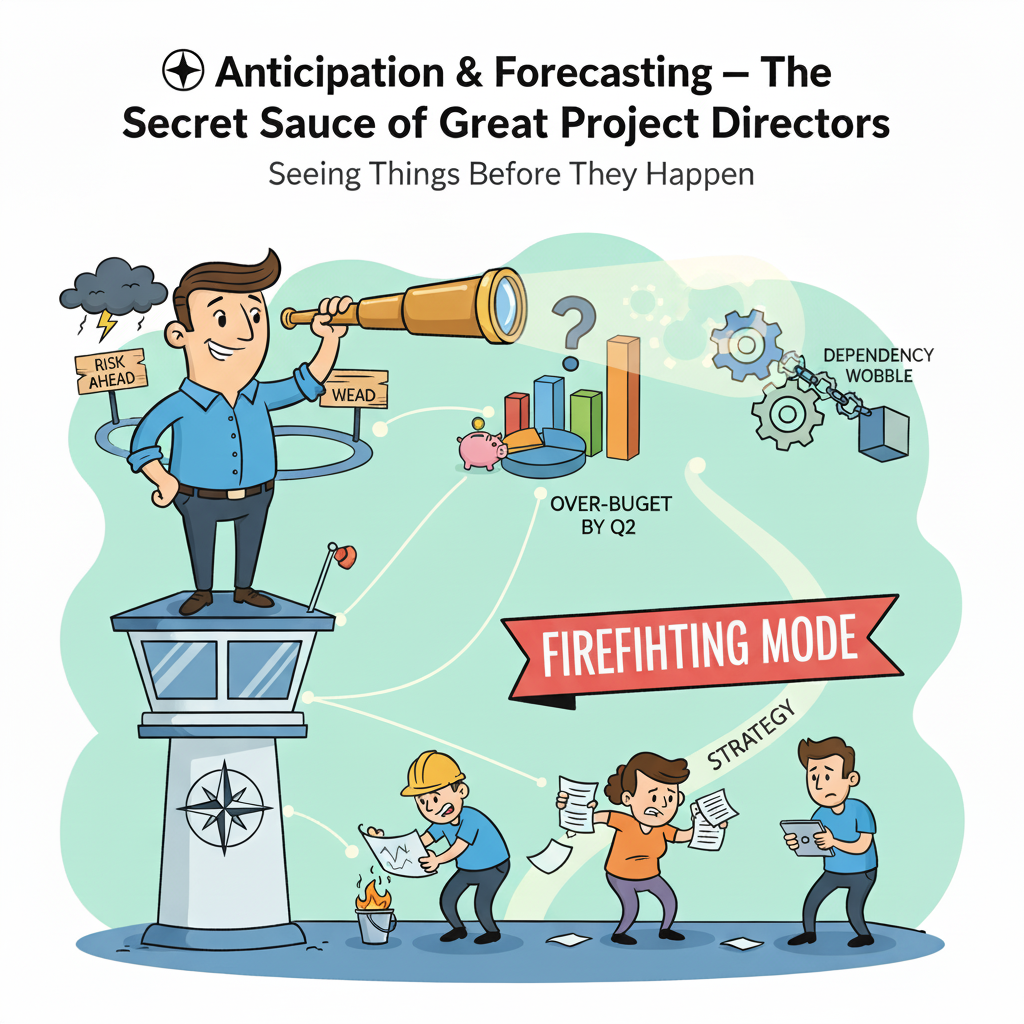
Reporting tells you where you are. Forecasting tells you where you’re going.
Most project governance systems are heavily weighted toward reporting.
They answer questions like:
- What did we spend?
- What did we complete?
- What is the current status?
These are necessary questions—but insufficient.
Leadership decisions are rarely about the present moment. They are about future consequences.
Forecasting shifts the conversation from:
“Are we on track today?”
to
“Where are we likely to be three months from now if nothing changes?”
That shift fundamentally alters how projects are led.
Why reporting-dominated leadership fails projects
Projects that rely primarily on reporting often share common symptoms:
- Late surprises
- Sudden escalations
- Reactive decision-making
- Overconfidence early, panic late
This happens because reports describe static snapshots, while projects evolve dynamically.
By the time a report turns red, the underlying problem has usually existed for weeks or months.
Forecasting exposes that drift earlier.
Forecasting is not prediction — it is disciplined anticipation
A common misconception is that forecasting requires certainty.
It does not.
Good forecasting accepts uncertainty and still asks:
- What trends are emerging?
- Which assumptions are weakening?
- Where is contingency being quietly consumed?
- What risks are becoming inevitable?
Forecasting is about direction, not precision.
That mindset aligns closely with sound risk thinking, especially when contingency and exposure are connected:
👉 https://projifi.blog/epc-risk-register-failure-fix/
How forecasting changes leadership behaviour
When project directors lead with forecasting, several things change immediately.
1. Conversations become forward-looking
Meetings stop revolving around:
- Who caused the issue
- Why last week slipped
- How bad things look now
Instead, they focus on:
- What is coming
- What decisions are needed
- What can still be influenced
This reduces blame and increases ownership.
2. Escalation happens earlier — and calmer
Forecasting enables early escalation.
Not because things are already bad, but because trends indicate they will be.
Early escalation preserves options. Late escalation removes them.
This connects directly to why communication failures derail projects:
👉 https://projifi.blog/5-reasons-projects-fail-team-communication/
3. Teams stop hiding behind optimism
Reporting systems often reward optimism.
Forecasting challenges it.
When teams must explain future trajectories, unrealistic assumptions surface faster. This creates healthier tension—one that protects delivery rather than undermines morale.
Forecasting vs micromanagement
Forecasting does not mean micromanagement.
In fact, it reduces it.
Project directors who forecast well:
- Ask fewer operational questions
- Intervene less frequently
- Focus on leverage points
Because they understand where the project is heading, they don’t need to chase every detail.
This supports leading without formal authority or constant supervision:
👉 https://projifi.blog/project-manager-without-authority-lead-anyway/
Where forecasting should focus (practically)
Effective forecasting does not try to forecast everything.
It concentrates on:
- Schedule trend vs remaining float
- Cost-to-complete vs remaining contingency
- Risk exposure vs management buffer
- Resource saturation vs upcoming milestones
These signals matter more than granular task completion percentages.
Forecasting reveals trade-offs early
Every project eventually faces trade-offs:
- Time vs cost
- Scope vs quality
- Risk vs speed
Forecasting exposes these trade-offs before they become crises.
That gives leadership the chance to decide deliberately, rather than react defensively.
This is especially important in environments prone to analysis paralysis:
👉 https://projifi.blog/overcoming-analysis-paralysis-leadership/
Why forecasting builds trust
Teams trust leaders who:
- See issues coming
- Act before pressure peaks
- Avoid emotional overreactions
Forecasting allows project directors to respond with composure instead of urgency.
Over time, this creates psychological safety—where teams surface problems early because they know leadership will respond constructively.
That dynamic consistently outperforms supervision-heavy leadership models:
👉 https://projifi.blog/why-trust-really-beats-supervision-in-epc-projects/
Common forecasting mistakes to avoid
Even well-intentioned leaders can undermine forecasting by:
- Treating it as a one-time exercise
- Demanding false precision
- Ignoring uncomfortable signals
- Using forecasts to assign blame
Forecasting only works when it is:
- Continuous
- Imperfect
- Used for decisions, not judgment
Forecasting is a leadership discipline, not a tool
Software helps. Dashboards help.
But forecasting is ultimately a way of thinking.
It requires leaders to:
- Accept uncertainty
- Challenge assumptions
- Act before certainty arrives
Those who master this discipline lead steadier projects—even in volatile environments.
📌 If you are a project director, remember this
- Reporting manages history
- Forecasting shapes outcomes
- Early discomfort prevents late chaos
- Calm escalation preserves options
- Leadership is about anticipation, not reaction
Final thought
Project directors do not lead better by knowing more about the past.
They lead better by seeing the future earlier.
Forecasting does not eliminate risk.
It gives leadership time.
And in complex projects, time is the most valuable control mechanism you have.
If this resonated, subscribe to Projifi.
Not just to read — but to interact.
Engage directly with the author, tap into lived delivery experience, and learn through cross-sharing with other experienced practitioners inside a growing, practitioner-led community.
That’s how judgment compounds — through experience, reflection, and conversation.


