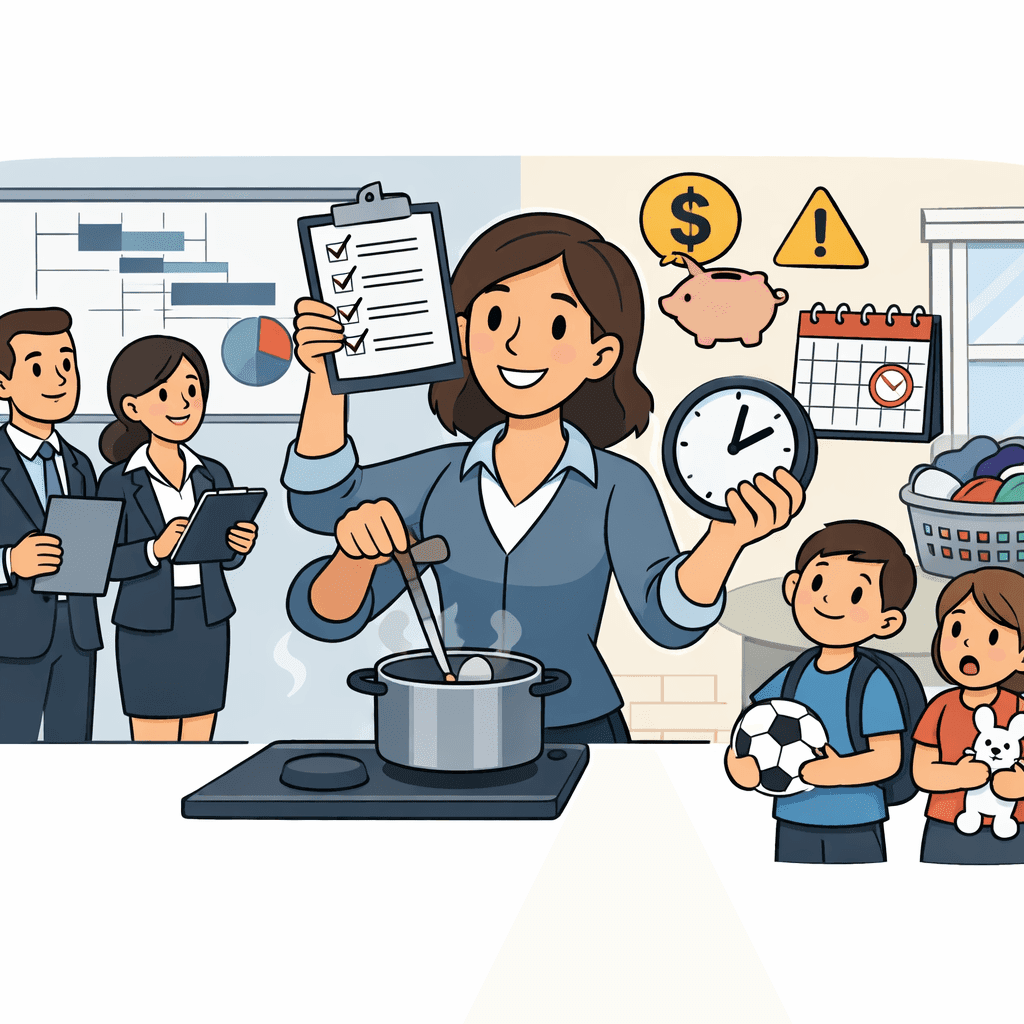
Why this article exists
Some of the most powerful Lessons from Motherhood I’ve witnessed did not come from textbooks, certifications, or corporate training programs.
They emerged from watching real life operate under relentless constraints — limited resources, competing priorities, emotional complexity, and absolutely no room for failure.
The most profound project management insights I’ve learned have come from observing motherhood up close — where leadership, resilience, prioritization, and stakeholder management are practiced every single day without titles, frameworks, or applause.
Not as a metaphor.
Not sentimentally.
But as a living system of planning, execution, risk management, budgeting, and stakeholder alignment — running every single day.

In brief
This article explores practical project management insights through Lessons from Motherhood, drawn from real-life observation of how complex responsibilities are managed daily. It covers planning, disciplined execution, proactive risk anticipation, budgeting control, and stakeholder management — demonstrating how judgment, adaptability, and foresight consistently outperform rigid frameworks in dynamic environments.
This guide brings together the core disciplines of project management — planning, execution, risk management, budgeting, and stakeholder alignment — as they naturally operate within a single, real-world system refined over years. Instead of treating these as isolated techniques, it illustrates how they integrate seamlessly in practice. That integration is precisely why Lessons from Motherhood remain universally relevant across projects, industries, and professional contexts.
Key Takeaway Box
What You Will Learn in This Article
The best project management insights often come from real-world responsibility rather than classrooms — a central theme explored in Lessons from Motherhood.
Proactive planning, even without formal instruction, translates directly into disciplined and reliable project execution.
Intelligent multitasking is about prioritizing what truly matters under constraints, not simply appearing busy.
Anticipatory risk thinking prevents issues before they escalate, unlike reactive crisis management that only responds after impact.
Stakeholder alignment is ultimately a judgment skill built on empathy, timing, and situational awareness — not merely a documented process.
Planning without being told to plan
One of the earliest Lessons from Motherhood I observed was the absence of formal instruction.
No one asked my mother to plan the day. There was no role definition, checklist, or governance framework.
Yet planning happened — quietly and consistently.
It went beyond cooking, covering the full rhythm of daily life: preparing clothes and uniforms, managing household needs, planning shopping, maintaining the home, and ensuring everything was ready before the day unfolded.
At the same time, she nurtured her children, managed emotions, balanced expectations, and remained engaged with neighbours and extended family.
Multiple responsibilities ran in parallel, without visible stress or planning tools.
In project terms, this is proactive planning without ceremony — something many teams struggle to achieve even with sophisticated systems.
Execution through intelligent multitasking
Execution in real environments is rarely linear.
What stood out was the ability to do many things at once without chaos.
Cooking several dishes simultaneously.
Managing household work while caring for children.
Switching contexts rapidly without losing control.
This wasn’t random multitasking. It was sequenced execution — knowing what could run in parallel and what required focused attention.
In projects, this distinction matters. Teams often confuse being busy with being effective.
Good execution is not about doing more.
It’s about doing the right things at the right time — often simultaneously.
This connects closely with how experienced leaders avoid endless deliberation and keep momentum alive, discussed further here:
https://projifi.blog/overcoming-analysis-paralysis-leadership/
Anticipating risk before it becomes a problem
Another powerful lesson was risk awareness — not reactive, but anticipatory.
Children, by nature, are unpredictable. Late waking, forgotten items, last-minute changes — these were not treated as rare events, but as expected behaviour.
Instead of reacting every time something went wrong, contingencies were built in advance. Extra buffers. Backup plans. Flexibility without panic.
In project language, this is risk planning grounded in reality, not optimism.
Many project risks escalate not because they were unknown, but because leaders refused to accept that they were likely.
Budgeting as a system, not an afterthought
Household budgeting offered one of the clearest parallels to formal cost control systems.
Money was never treated as a single pool. It was consciously divided into:
- Necessities
- Wishes
- Savings
And critically, there was always a buffer for rainy days.
Spending decisions were contextual, not emotional. Trade-offs were deliberate. Long-term stability mattered more than short-term gratification.
Many corporate budgeting frameworks are complex on paper but fragile in practice. Here, budgeting was reduced to first principles — and it worked.
Control did not come from restriction.
It came from clarity and discipline.
For readers who want a formal reference, these fundamentals align closely with classical cost management principles outlined by the Project Management Institute:
https://www.projectmanagement.com/articles/1127267/what-motherhood-taught-me-about-being-a-leader#_
Disciplined budgeting in projects also means knowing when contingency is being consumed faster than planned. Use the Project Risk vs Contingency Tool to track whether your mitigation costs are staying within budget — before the buffer runs out.
Stakeholder management in its purest form
Perhaps the most difficult — and most overlooked — capability highlighted in Lessons from Motherhood is stakeholder management.
Keeping children aligned is never trivial. Add siblings into the mix, and complexity multiplies:
Comparisons
Competing expectations
Ego clashes
Trust issues
Perceived unfairness
And yet, alignment was sustained.
Not perfectly. Not without friction.
But through constant communication, fairness, emotional intelligence, and consistent presence.
Everyone felt heard — even when outcomes were not identical.
In project environments, this remains the hardest leadership discipline to master. Processes rarely resolve stakeholder complexity. Judgment and empathy do.
This connects directly to how project managers often lead effectively without formal authority:
https://projifi.blog/project-manager-without-authority-lead-anyway/
The real-world pattern
Observed from lived experience:
- Proactive planning without instruction
- Intelligent multitasking during execution
- Anticipation of common risks and contingencies
- Disciplined budgeting with buffers
- Continuous stakeholder management amid emotional complexity
None of this relied on formal authority, tools, or frameworks.
And yet, the system worked — day after day.
In complex systems, success often comes not from rigid process, but from practical judgment applied consistently under real-world constraints.
Practitioner Insight
I have sat in project review meetings with seasoned engineers, senior planners, and experienced commercial managers — and watched execution collapse under pressure.
Then I think about the Lessons from Motherhood I observed growing up: a single person, no formal authority, no tools, no budgeting software — managing competing priorities, unpredictable stakeholders, and tight resources every single day without missing a beat.
The difference was never process. It was judgment, anticipation, and the discipline to keep going when things didn’t go to plan.
That remains the hardest capability to teach in any project environment.
Why these lessons matter for project managers
Project environments are not very different.
They involve:
- Limited resources
- Conflicting priorities
- Emotional stakeholders
- Unpredictable events
- No pause button
What often fails is not competence, but the assumption that formal structure alone will carry execution.
The reality is simpler and harder:
Good outcomes come from anticipation, discipline, adaptability, and judgment.
This is also why coordination-heavy roles are increasingly automated, while judgment-based leadership remains irreplaceable:
https://projifi.blog/are-project-management-jobs-safe-from-ai/
📌 What Project Managers Can Learn from Lessons from Motherhood
- Planning doesn’t require permission
- Execution works best when intelligently sequenced
- Risk is about likelihood, not surprise
- Budgets need structure and buffers
- Stakeholders respond to fairness, not formulas
- Judgment compounds through lived experience
Final thought
Some leadership skills are taught formally.
Others are absorbed through observation, reflection, and lived experience.
Seen through a project lens, Lessons from Motherhood are not a metaphor — they are a masterclass in operating under constraints.
Not everything valuable is shaped in boardrooms or classrooms.
Some of the most powerful lessons are already in motion — quietly, efficiently, and relentlessly — every single day.
FAQ
What project management skills can be learned from everyday life?
The core disciplines of project management — planning, execution, risk anticipation, budgeting, and stakeholder management — are all observable in well-run households. What makes these lessons valuable is that they operate without formal frameworks, authority, or tools. They are driven entirely by judgment, discipline, and anticipation. For project managers, recognising these skills in real-world systems sharpens the ability to apply them instinctively under pressure.
Why do formal project management frameworks sometimes fail in practice?
Frameworks provide structure, but they do not provide judgment. Most project failures happen not because a methodology was wrong, but because execution required adaptability that no framework can mandate. Real delivery environments — like complex households — succeed because the person running them anticipates problems, sequences tasks intelligently, and adjusts without waiting for a process to tell them to. Frameworks work best when they support judgment, not replace it.
What is the difference between multitasking and intelligent sequencing in projects?
Multitasking — doing many things at once without structure — typically reduces quality across all tasks. Intelligent sequencing means understanding which tasks can run in parallel safely, which require focused attention, and how to switch between them without losing control. Strong project managers, like experienced household managers, instinctively know the difference. They are not busier — they are better at choosing what to do simultaneously and what to protect.
How does anticipatory risk management differ from reactive risk management?
Reactive risk management responds to problems after they occur. Anticipatory risk management accepts that certain events — delays, last-minute changes, resource gaps — are not surprises but predictable patterns, and builds contingencies before they strike. The most effective project managers treat common risks the way experienced parents treat children’s unpredictability: not as exceptions, but as baseline assumptions built into every plan.
Why is stakeholder management considered the hardest project management skill?
Because it cannot be solved with process. Stakeholders bring competing expectations, emotions, ego, and history into every interaction. Aligning them requires fairness, consistency, emotional intelligence, and presence — not just governance structures. The same is true in any environment where multiple people with different priorities must be kept engaged and moving in the same direction. Tools help track it. Judgment is what actually manages it.
If this resonated, subscribe to Projifi.
Not just to read — but to interact.
Engage directly with the author, tap into lived delivery experience, and learn through cross-sharing with other experienced practitioners inside a growing, practitioner-led community.
That’s how judgment compounds — through experience, reflection, and conversation.


