
Who this is for
This article is written for young and early-career project managers who are beginning to interact with project finance teams and wondering why revenue numbers rarely match what they see happening on site or in execution.
It’s based on personal learning, not theory.
The question I asked early in my career
Early in my career as a project manager, I used to struggle with one question:
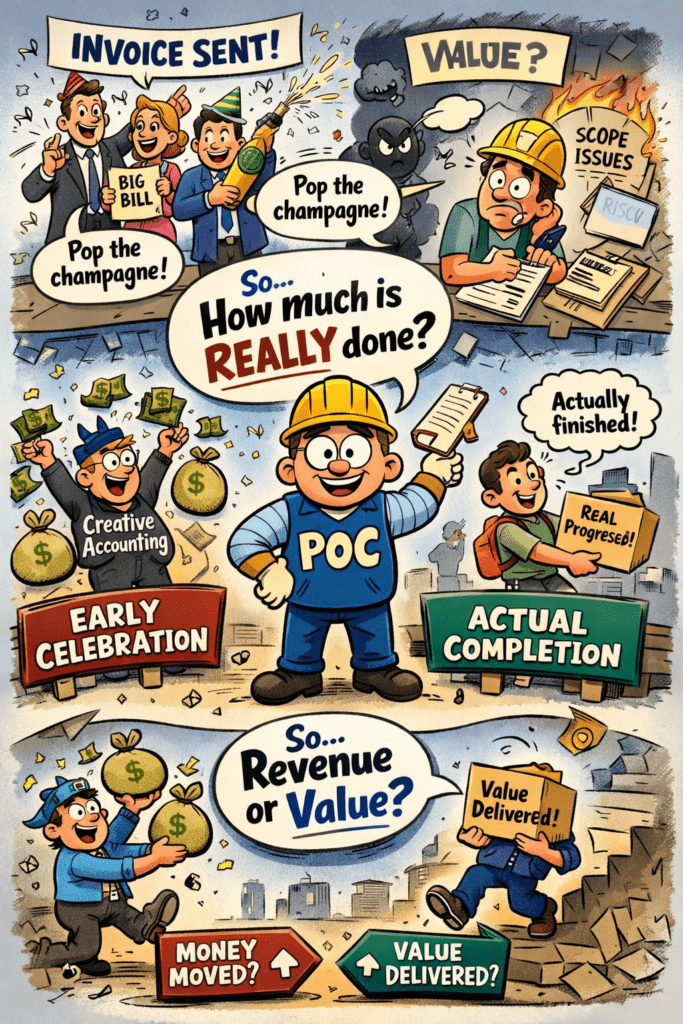
“If we’ve billed the client, delivered equipment, or completed milestones, why isn’t that the revenue?”
To me, it seemed logical.
Work was happening.
Invoices were raised.
Goods were accepted at site.
So why was project finance reporting revenue based on percentage of cost incurred instead?
I’ll be honest — I had some very naïve arguments with finance teams in those days.
Looking back, those arguments taught me one of the most important lessons of my project career.
The common (and dangerous) misunderstanding
Many young project managers assume that:
- Billing = revenue
- Site acceptance = revenue
- Milestones achieved = revenue
This thinking feels intuitive — but it’s incomplete.
The problem is that projects don’t fail suddenly.
They fail quietly, over time.
And incorrect revenue recognition is often the first place where reality starts drifting from what teams believe.
The logic behind percentage-of-completion (PoC)
What finally changed my thinking was understanding the logic — not the accounting — behind the percentage-of-completion (PoC) method.
In simple terms, PoC says:
Revenue should be recognised in proportion to the economic effort spent on the project — not just what has been billed or delivered.
The most common way to measure this is the cost-to-cost approach:
Recognised Revenue = (Cost Incurred ÷ Total Estimated Cost) × Total Contract Revenue
That’s it.
No complexity needed.
The idea is simple:
- If you’ve spent 40% of the total expected cost
- You’ve earned roughly 40% of the project revenue
This ties revenue to real effort and progress, not paperwork.
Why billing and milestones can mislead
Here’s where many projects quietly get into trouble.
Milestones can be front-loaded
Contracts can be structured so that:
- Large milestones occur early
- Billing happens well ahead of real value delivery
On paper, revenue looks healthy.
In reality, risk is piling up quietly in the background.
Revenue can get ahead of value
When revenue recognition runs faster than actual progress:
- Early optimism builds
- Problems get masked
- Cost overruns show up late
This is how projects end up with:
“Surprise losses” in the later stages
And those losses feel shocking only because the warning signs were ignored early.
The moment it clicked for me
Once I understood PoC properly, something important changed.
I stopped seeing revenue recognition as:
- A finance rule
- A reporting nuisance
- An administrative exercise
And started seeing it as:
A truth-telling mechanism about project health
PoC forces uncomfortable questions early:
- Are we underestimating total cost?
- Is progress real or just visible?
- Are we optimistic or honest?
That discomfort is a feature, not a flaw.
Why PoC actually protects project managers
This may sound counter-intuitive, but correct revenue recognition:
- Protects PM credibility
- Prevents false confidence
- Forces early corrective action
Projects that “look good” early but collapse later usually share one thing:
Revenue ran ahead of reality
PoC helps prevent that.
It doesn’t stop problems — but it reveals them early, when they can still be fixed.
A leadership lesson hidden inside revenue numbers
Here’s something young PMs rarely get told:
Revenue recognition shapes behaviour.
If teams are rewarded based on:
- Early billing
- Aggressive milestones
- Short-term numbers
They will optimise for optics, not outcomes.
When revenue is tied to real progress, behaviour improves:
- Cost estimates get more honest
- Risks surface earlier
- Decisions become grounded
This links directly to broader execution discipline and avoiding analysis paralysis, where teams hide behind activity instead of action.
👉 https://projifi.blog/overcoming-analysis-paralysis-leadership/
What I wish I had known earlier
If I could speak to my younger self — or to any young PM — I would say this:
- Finance is not “slowing you down”
- Revenue recognition is not about cash flow
- Early optimism is dangerous
- Late surprises are worse
Understanding revenue recognition early makes you:
- A better planner
- A better communicator
- A more credible leader
A simple mindset shift for young PMs
Instead of asking:
“Why can’t we recognise this revenue yet?”
Ask:
“What is this revenue number telling me about project reality?”
That one shift changes everything.
If you’re a young project manager, remember this
Keep this checklist close:
- Billing does not equal revenue
- Milestones can lie
- Cost trends tell the truth early
- Overstated revenue today becomes pain tomorrow
- PoC is a mirror — not an obstacle
- Work with finance, not against them
These lessons are far easier to learn early than after a project goes sideways.
Final thought
Every experienced project manager has a moment when reality corrects optimism.
Understanding project revenue recognition early helps you avoid learning that lesson the hard way.
Revenue numbers are not just financial metrics.
They are signals.
Learn to read them early — and your future self will thank you.
📌 If You’re a Young Project Manager, Remember This
- Billing is not revenue
Invoices and cash flow matter—but they don’t tell you how healthy your project really is. - Milestones can lie
Early milestones can make a project look successful while risks quietly build underneath. - Cost trends tell the truth early
Watch how costs move against estimates. They reveal reality faster than progress reports. - Overstated revenue today becomes pain tomorrow
Projects rarely fail suddenly. They unravel when optimism goes unchecked. - Percentage of Completion is a mirror, not an obstacle
It doesn’t slow projects down—it forces honesty when it still matters. - Work with finance, not against them
The best project managers use revenue numbers as signals, not arguments.
Explore more practitioner insights
For more experience-led insights on leadership, execution, and project reality, explore project leadership and execution insights on Projifi:
👉 https://projifi.blog/


