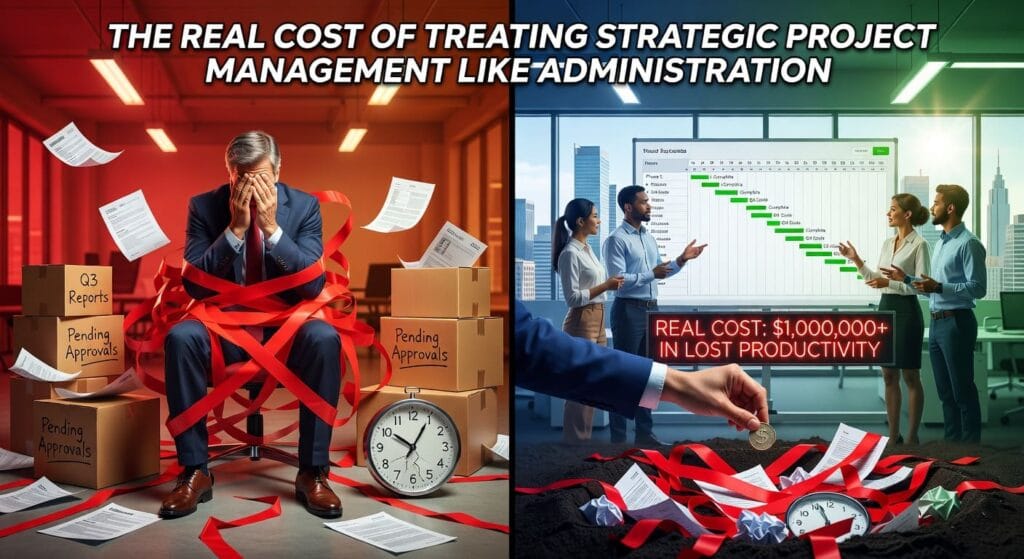
Your organisation has a project manager. But does it actually have one? Because there’s a version of the PM role that exists on paper — in job descriptions, org charts, and sprint reviews — and then there’s the version that actually moves the needle. Most companies are paying for the first one and wondering why delivery keeps disappointing them.
Project Management isn’t a misunderstood discipline. The frameworks are documented. The certifications are abundant. The tools are everywhere. What’s missing isn’t knowledge — it’s leverage. Organisations consistently compress what is fundamentally a strategic function into an administrative one, and the cost of that compression shows up in every delayed launch, every blown budget, and every team that looks busy but feels stuck.
📋 Key Takeaways
- Most organisations hire PMs for coordination but need them for strategic project management judgment — and the gap is where projects fail.
- A strategic project manager is simultaneously a risk detector, pressure absorber, scope guardian, and decision-maker under uncertainty.
- Treating PMs as administrators removes the early warning system from your projects.
- If a project were a company, the PM is its CEO — responsible for vision, people, money, risk, and outcomes.
- The organisations that win consistently empower PMs as strategic project management operators, not task trackers.
The Coordinator Trap: What Companies Think They’re Hiring

Ask most stakeholders what a PM does and you will hear the same shortlist. Schedule meetings. Send status updates. Chase deliverables. Keep the RAID log tidy. It is not wrong — those things happen. But calling that strategic project management is like calling a surgeon someone who books theatre slots and writes discharge notes. Technically accurate. Strategically blind.
When organisations define the PM role narrowly they create a ceiling on what that person can contribute. The PM who could have caught a £200k risk in week two is instead formatting a status report nobody reads carefully.
Activity Is Not Delivery
The most dangerous projects are not the ones that look troubled. They are the ones that look busy. Meetings are full. Trackers are updated. Velocity is green. And yet three months in, the team is no closer to an outcome. A coordinator-PM measuring inputs rather than outputs will not catch it until it is too late. This is exactly what strategic project management exists to prevent.
Why Organisations Default to This
It is easier to measure administrative output than strategic contribution. You can count meetings facilitated. You cannot quantify the risk that never became a crisis because a strategic project manager read the signals early. So organisations optimise for what is visible and systematically underinvest in what matters.
💡 The measurement problem: According to PMI’s Pulse of the Profession, organisations waste an average of $97 million for every $1 billion invested due to poor project performance. The root cause is rarely technical failure — it is strategic misalignment and late risk detection. Both are core strategic project management responsibilities, not coordinator functions.
What a Strategic PM Actually Does
The high-leverage PM operates in a completely different register. They are not managing tasks — they are managing tension. Between urgency and accuracy. Between ambition and feasibility. Between what leadership wants to hear and what the project needs them to know.
They Are the Project’s Early Warning System
A good PM scans constantly — not just the schedule, but the signals. A vendor who has gone quiet. A dependency two teams are each assuming the other owns. A stakeholder whose silence means disagreement, not alignment. They detect risk before it becomes financial damage and escalate with evidence, not alarm.
They Absorb Pressure So the Team Doesn’t Have To
The role means acting as a buffer between organisational politics and the delivery team. External pressure from executives, clients, or regulators gets translated into what the team needs to act on — and the noise that would shatter focus gets absorbed. The team delivers. The PM manages the environment that makes delivery possible.
They Have the Steel to Speak Up
A strategic project manager tells leadership clearly and early when the current trajectory will not land. Not with panic. Not with blame. With data, options, and a recommendation. The PM who stays quiet to avoid conflict is not protecting the project — they are delaying the crisis and making it more expensive.
They Guard Scope Like It’s Cash — Because It Is
Scope creep is the silent budget killer. It arrives as a reasonable-sounding request from a reasonable-sounding stakeholder. The right PM recognises these moments, documents them rigorously, and processes them through a formal change mechanism or holds the line. Every undocumented scope addition is an unpriced liability.
🤖 Practitioner Insight
In a decade of working in and around project delivery, I have watched the same pattern repeat across industries. Companies hire a PM, place them in meetings, give them a tracker, and then express surprise when projects still slip. The title is there. The strategic project management function is not.
The PMs who genuinely move outcomes are a different animal entirely. They are the project visionary — the one person holding the full picture when everyone else is heads-down in their lane. They are creatively relentless in solving problems others have declared unsolvable. They have owl eyes for detail — financial exposure, technical risk, contractual obligation — while keeping one eye on the horizon. They are the sane steady voice when a room is about to make a panic-driven decision. They have the steel to speak up when something is going wrong, the torch to escalate risks early, and the vigilance to catch and document scope creep before it eats the budget.
If you treat a project as its own company — with a P&L, a team, a strategy, and a market — then the strategic project manager is its CEO. Not the most senior person in the room. The most accountable one. And the organisations that understand that stop wondering why their projects fail and start consistently delivering.
— based on a decade of practitioner experience | projifi.blog
The PM as Project CEO: A Different Mental Model
Imagine the project as its own company. It has a budget. A team. A strategy. A market. Risk. Now ask who is running it.
Not the sponsor — they are the board. Not the workstream leads — they are the functional heads. The strategic project manager is the CEO. Responsible not just for execution but for vision, cohesion, decisions under pressure, and outcomes. That is not a metaphor. That is what the role looks like when it is being done well.
Vision: Keeping the End in Sight
Every project hits a phase where the team loses the forest for the trees. The PM re-surfaces the vision — why this project matters, what good looks like — and uses it to re-orient decisions and energy when momentum stalls.
Creativity: Solving What Others Have Given Up On
When a vendor falls through or a key person exits mid-delivery, a delivery leader does not just escalate. They return with options, trade-offs clearly articulated. That is not coordination. That is leadership.
Decisions Under Pressure
Projects regularly produce high-pressure decision moments. A go/no-go nobody wants to own. A quality-versus-timeline trade-off. The strategic project manager does not defer these. They make the call — or create the conditions for the right call — with a clear head and evidence to back it.
💡 The real cost: When PMs are confined to coordination, execution turns reactive, accountability fragments, and adoption weakens. The project finishes — eventually — but never at the quality achievable with genuine strategic project management at the helm.
What Needs to Change: For Organisations and PMs Alike
The under-leveraging of project management is a two-sided problem. Organisations need to stop structuring the role as administrative and start resourcing it as strategic. But PMs also need to step into that space — not wait for permission to lead.
What Needs to Change
For Organisations
Redefine what you measure. If your PM metrics are all schedule adherence and meeting frequency, you are measuring the wrong things. Measure risk detection lead time, decision velocity, stakeholder alignment quality, and scope change discipline. Give the strategic project manager a seat where strategy is being set — not just reported on.
For PMs
Stop waiting for the role to expand around you. Operate at the level of the outcome. Document the risks you caught early. Make the calls you have been avoiding. Speak up when the wrong decision is about to be made. Build the credibility that earns trust — and then use that trust to practise strategic project management at its full potential.
Frequently Asked Questions
What’s the difference between a project coordinator and a strategic project manager?
A coordinator manages activity — meetings, trackers, status updates, chasing actions. A strategic PM manages outcomes — risk, decisions, stakeholder alignment, scope integrity, and delivery velocity. Both are real roles. The problem is when organisations hire for strategy but structure for coordination.
How do I know if my organisation is under-leveraging its PMs?
Ask yourself: are your PMs in the room when scope, budget, or strategic trade-offs are being decided? Or are they informed after the decision? If it’s the latter, you’re using them as recorders, not operators. Also look at risk logs — if risks are consistently appearing late, your PM function isn’t being positioned to detect them early.
Can a PM operate strategically even if the organisation hasn’t empowered them to?
Yes — and often they have to. Start by demonstrating strategic value in small, visible ways: bring a risk to a sponsor before it becomes a problem, propose a scope decision rather than just flagging the issue, show up to meetings with a recommendation not just a report. Credibility is earned before it’s granted. Build it deliberately.
Is the “PM as CEO” framing just a metaphor or does it have practical implications? hasn’t empowered them to?
It’s a practical mental model. A CEO is accountable for the whole — not just their department. They make decisions across functions, manage upward and downward, protect culture and pace, and own outcomes not just activities. When a PM internalises that accountability — even without the formal authority — their decision-making, communication, and risk posture all shift in measurable ways.
📖 Read More on Projifi
🔗 References & Further Reading
- Pulse of the Profession: The High Cost of Low Performance — Project Management Institute (PMI)
- The Project Management Office That Actually Works — Harvard Business Review
- Delivering Large-Scale IT Projects on Time, on Budget, and on Value — McKinsey & Company
The Question Every Organisation Needs to Answer
Strategic project management is not broken. It is being used wrong. The discipline has everything it needs — the frameworks, the talent, the methodology. What it lacks in most organisations is the structural respect to operate at its actual level.
The PMs who absorb pressure, detect risk early, speak uncomfortable truths, guard scope like cash, and hold the vision when the team is in the weeds — they do not just deliver projects. They compound results. They build the delivery credibility that makes organisations take on harder, more ambitious work.
So the question is not whether your organisation has project managers. It is whether you are letting strategic project management do what it actually can.