
In over a decade of delivering complex capital projects, the most consistent failure I have observed is not technical.
It is behavioural.
The way main contractors and employers treat their subcontractors is, in most cases, simply not good enough. And it is costing projects dearly — in time, money, relationships, and outcomes that could have been significantly better.
This article is about what I have seen, what actually works, and why the industry needs a fundamentally different approach to subcontractor relationships.
A quick overview
[Subcontractors are not a lower tier of suppliers requiring endless monitoring and control. They are the hands and minds physically driving your project forward — coordinating skilled labor, equipment, and materials, often while navigating financial pressures that most main contractors and employers rarely take the time to acknowledge. If you treat them purely as contract-bound entities, you may win the argument but risk undermining the success of the entire project.]
The hard reality of subcontractor relationships in construction
There is a fundamental inconsistency in how most EPC projects handle subcontractor relationships, and it remains an issue that few are willing to address openly.
Subcontractors are often regarded as lacking capability, requiring constant oversight, and needing improvement — yet they are tasked with performing the most labor-intensive and technically challenging work on site.
Main contractors and employers expect results but fail to provide the environment needed to achieve them.
They hold back payments. They apply contract terms selectively. They demand deployment of critical resources well before even a single payment is processed.
And then they question why progress falters.
I have seen this pattern unfold repeatedly across various projects and organizations. The dynamic begins with mistrust from the main contractor and financial strain on the subcontractor. From such a starting point, neither side is positioned to succeed.
This breakdown in subcontractor relationships is also one of the primary reasons projects face significant setbacks — not because of technical flaws, but because relationship tensions escalate under pressure until recovery is no longer feasible.
The harsh cash flow cycle everyone avoids discussing
Subcontractors operate on a precarious financial edge.
This is not the result of poor management. It is simply the financial model under which specialized construction businesses function. Long before receiving their first payment, they commit significant resources to workforce mobilization, equipment allocation, and purchasing materials. The financial risk is immediate and substantial, while the financial recovery is protracted.
When main contractors postpone payments — even when technically within the agreed terms — they are not just creating a financial strain. They are directly disrupting the rhythm of their own project.
I have witnessed subcontractor efficiency decline, not due to lack of expertise or poor management, but because of halted cash flow. Crews are quietly downsized. Equipment servicing is postponed. Material deliveries are stalled. The site slows down, and the connection to the payment schedule remains overlooked.
The solution in such cases was not stricter enforcement of contracts. It was the opposite approach.
On several occasions, I facilitated advance payments outside the conventional contract framework — with a clear recovery plan incorporated into subsequent progress invoices, repaid incrementally. Was this the most straightforward commercial setup? No. Was it vital for maintaining the pace of the project? Without a doubt.
The accounts were always balanced. But the project stayed alive because we prioritized collaboration over rigid adherence to paperwork during a period when paperwork alone would have jeopardized both parties.
This ties directly into how procurement arrangements are defined at the start of a project. The Procurement Strategies guide explores how payment terms and financial structures shape subcontractor relationships long before work begins on-site.
Understanding the overlooked value of subcontractors
Here is what most employers and main contractors fail to fully appreciate.
When challenges arise on large capital projects — and they always do — subcontractors are often the ones directly confronting those challenges. Not the employer’s representative. Not senior leadership from the main contractor.
It’s the subcontractor’s site team.
Drawing issues that were not their responsibility are resolved quietly, without extra charges, because initiating a formal claim would waste more time than simply addressing the issue.
Equipment breakdowns during critical phases — tackled not by requesting formal approvals but through inventive, on-the-spot field solutions. These practical and effective workarounds ensure the project progresses despite limited access to conventional options. It is a display of strategic thinking under high-pressure conditions, and its value cannot be overstated.
Deploying resources beyond what the contract requires — when the main contractor is under significant schedule pressure, dependable subcontractors don’t waste time checking whether such support falls within their contractual obligations. They focus on what the project needs and step up. Compensation follows, naturally. But their approach — the readiness to engage rather than retreat — is what sets them apart.
I’ve seen subcontractors take responsibility for on-site issues even in situations where the employer’s representative was absent. Not because they were at fault, but because someone needed to take ownership, and they were present.
This type of proactive behavior deserves a fundamentally improved subcontractor relationship — one that recognizes their essential role in project success.
Why relying solely on contracts damages subcontractor relationships
A strictly legalistic approach to managing subcontractors might appear secure. Every agreement is on paper. Every duty outlined. Every variation officially documented.
However, in reality, it fosters a culture where individuals do nothing beyond what is explicitly required.
Mistakes in designs are filed as formal complaints instead of being addressed. Requests for additional resources lead to prolonged negotiations instead of swift action. Issues that could be solved in a few hours turn into protracted conflicts lasting weeks.
The contract itself remains a crucial baseline. It must — projects cannot rely solely on good intentions, and financial records must always balance accurately.
Yet, the gap between basic contractual compliance and outstanding project outcomes is bridged by mutual respect, rapport, and the readiness to support one another when challenges arise.
Contractors who rely only on rigid contractual enforcement lose access to this vital middle ground.
The repercussions go far beyond the scope of a single project. As I previously discussed in Building Trust in EPC Projects, a strained subcontractor relationship in one project can carry over to future collaborations. In an industry where reputation spreads rapidly, the consequences are often underestimated.
A practical vision for improving subcontractor relationships
The subcontractors I have seen perform best were not those forced to operate under relentless contractual rigidity.
They were the ones who believed the main contractor had their best interests at heart — that when they flagged an issue, it would be addressed with genuine concern rather than dismissed. That when financial strains arose, there would be a meaningful dialogue instead of a robotic invocation of contract terms.
This did not imply compromising on standards. Performance benchmarks remained steadfast. Safety was paramount. Quality expectations were unwavering.
But the dynamic surrounding these benchmarks was collaborative rather than combative.
In practical terms, this manifested as
- Open, transparent discussions about financial status and allocation — beyond just scheduled updates
- Upfront financial support with a clear plan for repayment during critical moments of necessity
- Recognizing when subcontractors exceed expectations without prompting — and ensuring that recognition is both public and genuine
- Involving them in collaborative discussions to address challenges, instead of delivering pre-made decisions
- Valuing their on-site expertise as essential knowledge that directly contributes to success — because it truly does
The mindset that defines exceptional subcontractor relationships
Not every subcontractor reaches the standard described above.
Yet, those who do — the ones who address issues without fanfare, who devise practical solutions under tight deadlines, who allocate extra resources on request without immediately demanding additional compensation — are indispensable assets to any endeavor.
Replacing them mid-project entails significant expense, delays, and upheaval.
They should never be treated as though they are easily replaceable.
Identifying subcontractors who consistently operate at this level — and fostering a strong subcontractor relationship with them — is among the most undervalued skills in EPC project leadership. It ties directly to the larger challenge of what sets top project leaders apart — the ability to nurture partnerships that thrive even under the toughest circumstances, not just when everything runs smoothly.
Addressing subcontractor underperformance while preserving the relationship
There are moments when performance genuinely falls below expectations — not due to financial strain or outside influences, but because of ineffective leadership, insufficient resources, or conflicting objectives.
These moments call for a different approach.
The first step is a candid conversation — not a formal reprimand, not an invocation of contract clauses, but an open dialogue to understand what is happening and why.
In my experience, the majority of subcontractor performance challenges stem from an identifiable root cause that can often be resolved. Addressing that cause early — before it escalates into a formal dispute — is nearly always the better course of action.
If escalation does become unavoidable, it should be measured and thoroughly documented. Even then, the focus should remain on resolution, not replacement. Swapping subcontractors mid-project is one of the most costly and disruptive decisions a main contractor can make. The expenses — re-mobilization, onboarding time, schedule setbacks — frequently outweigh the issues caused by underperformance.
Key Questions and Answers About Subcontractor Relationships
Why do main contractors face challenges in building strong subcontractor relationships?
In my experience, the root issue is mindset. Subcontractors are often treated as a lesser tier of supplier rather than as collaborators in project delivery. This impacts everything — from how payment terms are set to the tone of site discussions when challenges arise. Once this approach takes hold, changing it becomes nearly impossible under the intense demands of a project.
Managing subcontractor cash flow: balancing support with accountability
The key lies in creating structured pre-payments with a well-defined recovery process—recouping the upfront amount via incremental deductions from future invoices as mutually agreed. This approach ensures uninterrupted progress while maintaining accurate financial records. It depends on mutual confidence and precise record-keeping but is significantly less harmful than letting a financially strained subcontractor slow the project’s critical momentum.
Why resourceful problem-solving is vital in EPC projects
Resourceful and inventive problem-solving is often the unsung hero of project execution. It’s about crafting practical fixes using what’s at hand rather than waiting for perfect scenarios. On EPC sites, this translates to a subcontractor’s team swiftly addressing equipment breakdowns or inaccuracies in drawings—issues that might otherwise face prolonged resolution through standard protocols. This approach represents sharp, adaptive thinking under challenging circumstances, showcasing the true value of fostering a strong subcontractor relationship.
Striking the balance: firmness versus support in subcontractor relationships
Hold firm on safety, quality, and meeting crucial project timelines — these principles are non-negotiable, no matter the strength of the subcontractor relationship. Be empathetic and supportive when challenges are external: financial strain, design inaccuracies outside their responsibility, or staffing and equipment shortages caused by external conditions. The distinction is critical. Forcing contractual obligations on issues that require collaboration is one of the fastest ways to escalate a challenging situation into a crisis.
The unseen contributions of subcontractors on EPC projects
Subcontractors contribute far more than they are given credit for. They resolve design inconsistencies without escalating them into formal disputes. They devise practical solutions to critical on-site challenges, stepping in when immediate action is required. They allocate extra resources promptly, even when the contract does not explicitly demand it. And they assume responsibility during pivotal moments when employer representatives are unavailable. These efforts rarely get documented in contracts but are integral to the success of any subcontractor relationship and to whether the project ultimately succeeds.
The ripple effects of poor subcontractor relationships on project success
Delayed payments disrupt progress on site. Strained dynamics erode trust, discouraging efforts beyond basic contractual obligations. Strictly transactional oversight removes the collaborative adaptability needed to navigate intricate challenges. The outcome is a project that meets contractual terms — but falls short of the deeper coordination and problem-solving a successful subcontractor relationship demands.
Closing perspective
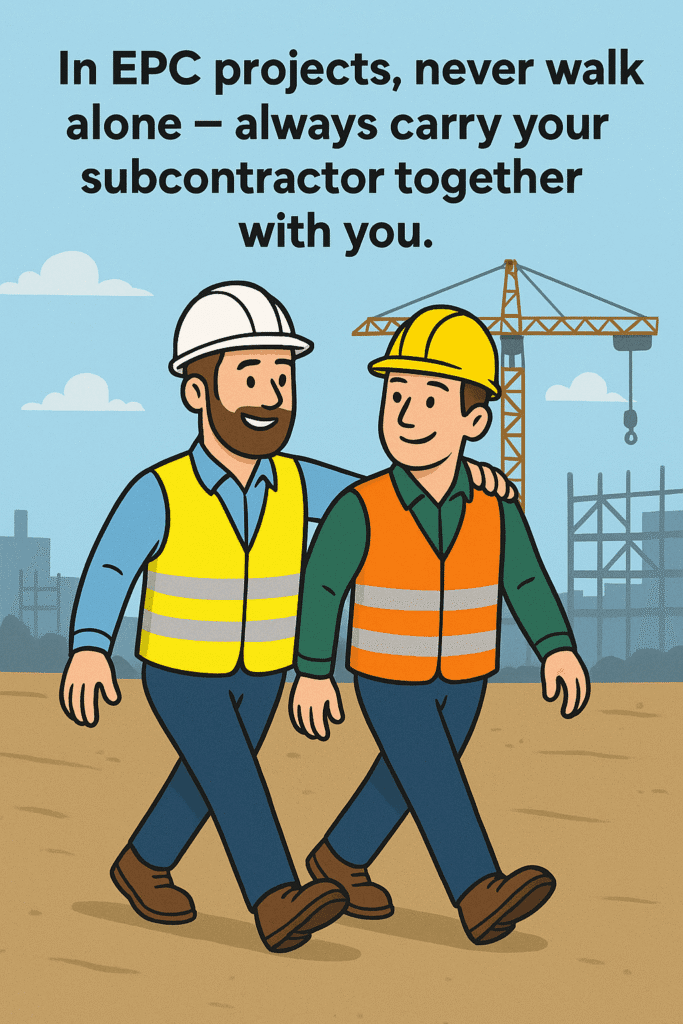
I once shared this on LinkedIn: “In EPC projects, success comes when you and your subcontractor move forward together as a team.”
The feedback I received from industry professionals reaffirmed what years of experience had already shown me: this message strikes a chord because it mirrors a truth that most in EPC projects understand but seldom put into practice.
Subcontractors are not just vendors; they are integral to project execution. They show up when needed, tackle challenges beyond their scope, and sustain progress even under tough conditions.
What they truly deserve is fair compensation, genuine respect, and meaningful support whenever the situation calls for it.
Not just because it’s ethical.
But because it’s the foundation of a strong subcontractor relationship — and the only way to deliver the project successfully.
For further reading on this topic please refer the following articles too:
If this struck a chord, subscribe to Projifi — real-world insights for managing complex projects.


